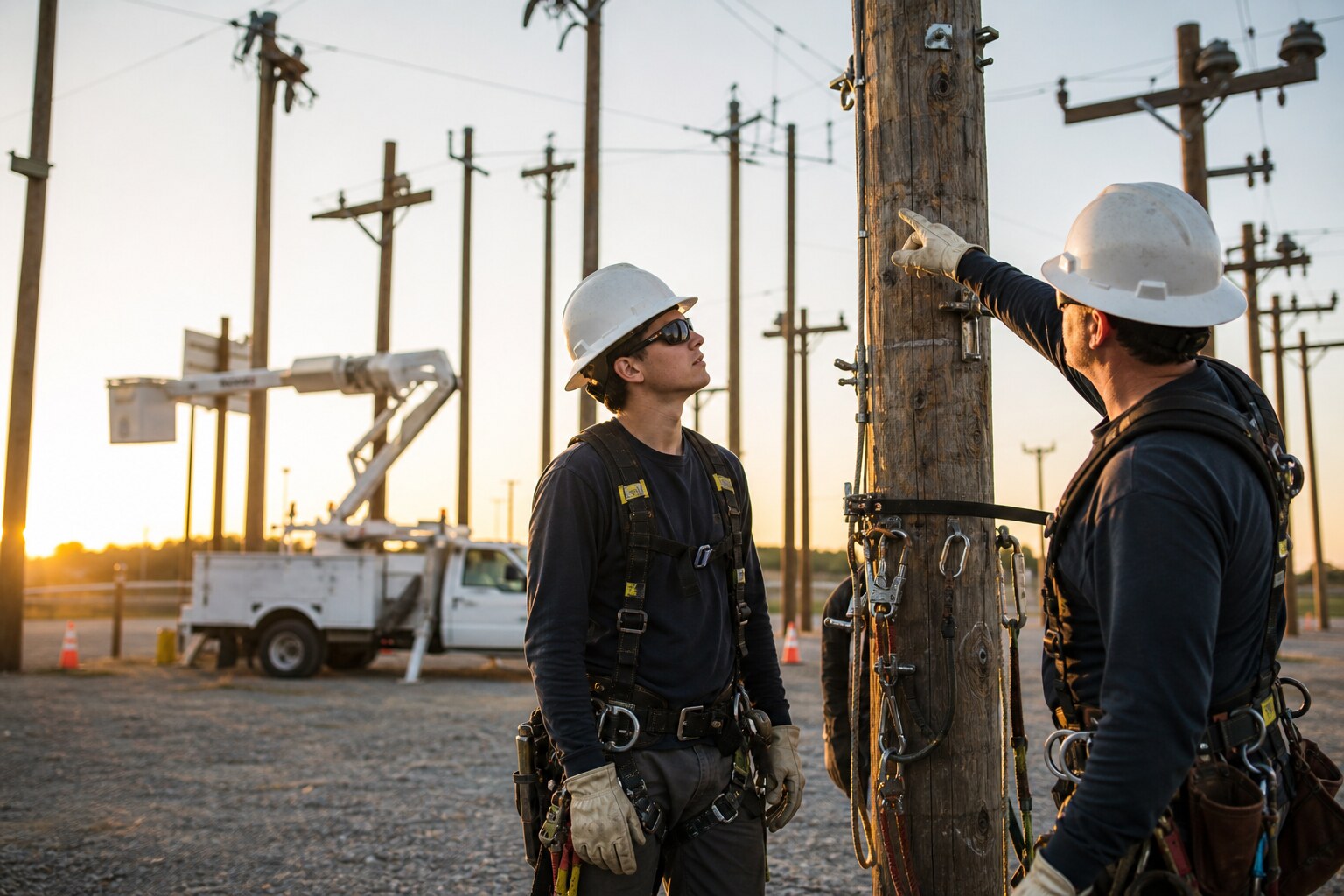
To become a lineman apprentice, start with the employers and apprenticeship programs that hire in your area, not with a school catalog. Your goal is usually to get hired into a paid apprenticeship or another employer-sponsored training position. Line school may help you qualify or compete, but it is not a universal first step.
A practical starting plan is:
- Find the utilities, cooperatives, municipalities, line contractors, and outside-line apprenticeship programs that serve your region.
- Write down the requirements from each official application page.
- Apply now where you meet the minimum qualifications.
- Spend money on training only when it closes a specific gap, such as a CDL requirement or preparation an employer clearly prefers.
That order matters. It keeps you from paying for a program that your target apprenticeship does not require or recognize.
What a lineman apprenticeship actually is
A lineman apprenticeship is both a job and a structured training program. You work under experienced journey-level lineworkers, complete technical instruction, and advance as you develop the required skills and hours.
The U.S. Department of Labor says a Registered Apprenticeship includes paid work, mentorship, classroom instruction, progressive wage increases, and a portable credential. Other employer-sponsored programs may be structured differently, so ask what credential you will earn and how advancement works before accepting an offer.
It helps to understand the difference between an apprenticeship and line school:
- In an apprenticeship, you are employed and learning on the job.
- In line school, you are a student preparing for entry-level work and usually paying tuition and related costs.
Paid does not always mean cost-free. Depending on the program, an apprentice may still be responsible for application or testing fees, books, tools, travel, lodging, or other expenses. Read the current program agreement and wage information rather than relying on a general promise to “earn while you learn.”
The main ways into a lineman apprenticeship
There is no single national application that covers every lineman or lineworker apprenticeship. Opportunities are offered by different employers and program sponsors, and each sets its own hiring schedule, service territory, and requirements.
Apply directly to a utility or other employer
Electric utilities, electric cooperatives, municipal power departments, and line contractors may hire apprentice lineworkers into their own training programs. Job titles vary, so search for apprentice lineman, apprentice lineworker, line apprentice, groundman, line helper, pre-apprentice, and lineworker trainee.
Some employers hire first-step apprentices. Others look for candidates who already have relevant experience, a commercial driver's license, or prior line-school training. For any specific opening, the job posting is the final word.
You can begin with current apprentice lineman jobs and broaden the search through all lineman job listings.
Apply through an outside-line apprenticeship program
Joint union-contractor outside-line apprenticeships combine paid field experience with technical instruction. The Electrical Training Alliance's outside-lineman overview describes apprentices learning safe practices under journey-level supervision while training for work on transmission and distribution systems.
Use the Electrical Training Alliance's outside training-center locator to identify programs serving your region. A program may cover several states, require travel within its jurisdiction, and accept applications only during certain periods.
Use an entry-level line job as a bridge
A groundman, helper, or pre-apprentice role may provide experience around line crews, materials, equipment, and jobsite expectations. It is not automatically an apprenticeship and does not guarantee advancement. Before accepting a role, ask whether it includes structured training, whether the hours count toward anything, and whether there is a defined route into an apprenticeship.
Consider line school when it solves a specific gap
Line school can introduce climbing, tools, electrical basics, safety practices, and equipment. It may help if you have no construction or utility experience, or if a target employer prefers line-school graduates. It is still preparation for employment. It does not replace an apprenticeship.
Do not enroll only because a school says line school is the standard first step. Check the apprenticeship programs and employers you intend to apply to. Some may value the credential or give relevant training credit, while others may hire qualified applicants without it.
How the application process usually works
The exact process varies, but many applicants move through some version of these stages:
- Find an open application. An employer may post a specific apprentice job. A program sponsor may accept applications for a future ranked list.
- Confirm the minimum requirements. Check the official page again immediately before applying. A missing document or expired license can stop an otherwise qualified application.
- Submit supporting records. Common examples include a diploma or GED, transcript, driver's license or CDL documents, work history, and military records when applicable.
- Complete the program's selection steps. Depending on the sponsor, this may include an aptitude test, interview, physical assessment, orientation, or screening.
- Wait for selection or a job assignment. Passing the minimum requirements does not always mean an immediate start. Some programs rank qualified applicants and select from that list as contractors need apprentices.
For example, the Northeastern Apprenticeship and Training Program describes an application, aptitude test, interview, and ranked waiting-list process. The current SELCAT application page lists a different set of documents, licenses, residency rules, and travel expectations. These are useful examples of why you must follow your own program's current instructions rather than a national checklist.
Keep copies of everything you submit, note deadlines, and check your email and voicemail. Application windows and contact information can change while you are preparing.
Qualifications you will commonly see
The U.S. Bureau of Labor Statistics says electrical power-line installers and repairers typically enter with a high school diploma or equivalent and develop proficiency through technical instruction and long-term on-the-job training. Apprenticeships are common. Beyond that baseline, requirements vary by employer, program, and state.
High school diploma or GED
Typical expectation: A high school diploma or equivalent is the usual entry-level education for the occupation.
Verify with the program: Whether transcripts are required and whether the program expects algebra coursework.
Minimum age
Typical expectation: Many apprenticeship programs set a minimum age, often 18.
Verify with the program: The exact age rule for the employer or apprenticeship.
Driver's license or CDL
Typical expectation: Line crews operate trucks and other heavy vehicles, so a valid driver's license and a CDL are common requirements.
Verify with the program: Whether a permit is enough to apply, which CDL class is required, and the deadline for obtaining it.
Aptitude or algebra preparation
Typical expectation: Some apprenticeships require algebra coursework, an aptitude test, or both.
Verify with the program: Accepted coursework, test format, and retesting rules.
Physical ability
Typical expectation: The work can include climbing, lifting, heights, confined spaces, and outdoor work in difficult weather.
Verify with the program: Any fitness test, vision or medical standard, and the process for requesting a reasonable accommodation.
Travel or residency
Typical expectation: A program may dispatch apprentices across a multi-state territory.
Verify with the program: Residency rules, travel expectations, reporting time, and relocation costs.
Safety or substance screening
Typical expectation: Some employers and programs use substance screening or require safety credentials.
Verify with the program: The exact policy and when it applies.
Treat these qualifications as a preparation list, not a universal checklist. The BLS notes that workers who drive heavy vehicles usually need a state-issued CDL, but the class, endorsements, restrictions, and timing depend on the job and program. It also says apprenticeship qualifications may include algebra, aptitude testing, physical requirements, and substance screening. That does not mean every apprenticeship uses the same rules.
Is line school required?
No national rule requires line school before someone can become a lineman apprentice.
The BLS describes vocational programs and community-college training as helpful preparation, while also explaining that workers typically complete apprenticeships or other employer-sponsored programs. That distinction matters: a school may prepare you to compete for a job, but it does not replace checking the requirements of the apprenticeship you want.
Line school may be worth it when a specific employer requires or prefers it, the training fills a skill gap you know you have, or the included credentials match the programs you plan to pursue. If nearby programs already accept candidates with your background, applying directly may be the better first move.
Before paying tuition, ask the school for specific answers:
- What is the complete cost, including tools, housing, transportation, testing, and CDL expenses?
- Which credentials are included, and which require separate fees?
- Which employers or apprenticeships have confirmed that they recognize the training?
- Does the school publish recent completion and job-placement results, and how does it define “placed”?
- Will your target apprenticeship award credit or a hiring preference for the training, or will you still begin at the first step?
- Can you speak with recent graduates who pursued the same employers or programs?
- What is the refund policy if you leave or cannot meet a physical or licensing requirement?
Be cautious with guarantees. A school cannot control a utility's hiring needs, an apprenticeship's ranked applicant list, or when a local program opens applications.
Are you in the right area?
Location matters, but a quiet job market today does not necessarily mean you live in the wrong place. Utilities and apprenticeship programs hire as staffing needs change, and an outside-line program may serve a multi-state territory rather than one city.
Make a list of the options in your region:
- Browse lineman jobs by state to see where current openings are appearing.
- Search the federal Apprenticeship Job Finder using terms such as “line installer,” “lineworker,” and “lineman,” plus your location.
- Find your federal or state contact through the Apprenticeship.gov state offices directory.
- Locate outside-line training programs through the Electrical Training Alliance.
- Check the career pages of nearby investor-owned utilities, public power departments, electric cooperatives, and line contractors.
The federal finder is useful, but it is not the only place programs recruit. Apprenticeship.gov directs career seekers to apply with the employer or program sponsor, so keep checking official employer and training-center pages even when a national search returns nothing nearby.
If nearby opportunities are limited, decide how far you can realistically commute, travel, or relocate. Ask about dispatch territory, reporting time, travel-pay rules, personal-vehicle requirements, temporary housing, storm assignments, and how long you may be away from home.
Questions to ask before accepting an apprenticeship
An offer is the time to confirm the details you could not learn from the posting:
- Who is the employer and who is the program sponsor?
- Is it a Registered Apprenticeship, and what credential do completers receive?
- How are on-the-job hours and technical instruction documented?
- What is the starting wage, and what triggers each increase?
- What will you pay for applications, testing, dues, books, tools, travel, or training materials?
- What benefits begin immediately, and which have a waiting period?
- Where can you be assigned, and what happens during a layoff or reassignment?
- Which CDL, endorsements, medical card, or other credentials must you maintain, and by what deadline?
Get important terms in writing. A legitimate program should be able to explain its training structure, costs, wage progression, and completion requirements clearly.
What to do this week
- Gather your documents. Locate your diploma or GED, official transcript, driver's license, employment history, and any military, construction, first-aid, or equipment credentials.
- Build a regional employer list. Include direct utility programs, outside-line apprenticeships, cooperatives, municipalities, and line contractors within your realistic travel range.
- Create a requirements tracker. For each opportunity, record the application URL, opening dates, CDL rule, math rule, required documents, fees, travel territory, and your next action.
- Check your driving path. Read several real apprenticeship postings and identify the CDL class, endorsements, restrictions, and deadline they actually require before paying for training.
- Apply to roles you qualify for now. A preferred qualification is different from a minimum requirement. Let the employer decide whether the rest of your background is competitive.
- Work on one real gap. Request a transcript, study for an aptitude test, begin the right CDL process, or obtain a credential that appears in your target programs.
- Make job searching a routine. Review current apprentice openings, subscribe for new-job alerts, and recheck official employer and program pages every week.
A realistic starting point
You do not need to have the entire career mapped out before taking the first step. You need a short list of legitimate programs, their current requirements, and a plan for closing the specific gaps between your background and those requirements.
The trade can involve heights, high-voltage hazards, physical work, travel, storms, and long hours. Learn what the work is actually like as carefully as you research the pay. For a clearer picture of earnings, read the lineman salary guide, which explains what federal wage estimates include and what they leave out.
Use this guide to organize the search, but use the official application as the final authority. Requirements, application windows, and hiring needs change. Verify your plan against the BLS Occupational Outlook Handbook, Apprenticeship.gov career-seeker guidance, and the employer or program accepting your application.