A groundman job can move you toward becoming a journeyman lineman. It does not move you there by itself.
That distinction is easy to miss because employers use titles such as groundman, line helper, pre-apprentice, line assistant, and apprentice groundman in different ways. One groundman position may be a clearly defined feeder into an apprenticeship. Another may give you valuable crew experience but no guaranteed promotion, no apprentice credit, and no shorter path to journey level.
An apprentice lineman is different. Once you are officially accepted into a legitimate apprenticeship, you are in a structured training program designed to produce a journey-level lineworker. You work, complete related instruction, advance through defined steps, and document the skills or hours required by the program.
If your goal is to become a journeyman, the job title is only the first clue. The written training and advancement rules are what matter.
The short answer
If you have a real apprentice lineman offer and a groundman offer at the same time, the apprenticeship is normally the more direct route to journey level. It starts the formal training clock and puts your work inside a defined progression program.
A groundman job can still be a smart first move when it does at least one of these things:
- gives you legitimate electrical line-construction experience;
- helps you meet an apprenticeship requirement or become a stronger applicant;
- provides a written internal path to an apprentice position;
- lets you earn while continuing to apply to apprenticeships; or
- places you in the correct outside-line hiring system for your area.
The mistake is not taking a groundman job. The mistake is assuming that every groundman job automatically becomes an apprenticeship.
Groundman vs. apprentice lineman at a glance
Are you automatically in an apprenticeship? A groundman is not. The title alone does not establish apprentice status. An apprentice should be officially enrolled, indentured, or otherwise accepted into a structured employer or sponsored program.
What is the main purpose of each job? A groundman supports the line crew and performs the duties allowed by the employer, agreement, and the worker's qualifications. An apprentice learns progressively more linework under journey-level supervision while completing the program requirements.
Is related classroom instruction built in? Not necessarily for a groundman. It should be part of a formal apprenticeship.
Do the hours count toward journey level? Groundman hours do not count automatically. They may count as experience, referral hours, or a hiring qualification without reducing the apprenticeship. Program-approved apprentice hours or competencies count toward completion when they are properly recorded.
Are wage increases tied to progression? For a groundman, that depends on the employer or agreement. A legitimate apprenticeship should have a defined wage or step progression.
What is the usual outcome? A groundman may gain work experience, build a crew-support career, or create a possible route into an apprenticeship. An apprentice works toward journey-level status or a completion credential by meeting every program requirement.
These are general distinctions, not national job descriptions. A collective bargaining agreement, apprenticeship standard, utility progression plan, or job posting may set different duties and requirements.
What does a groundman do?
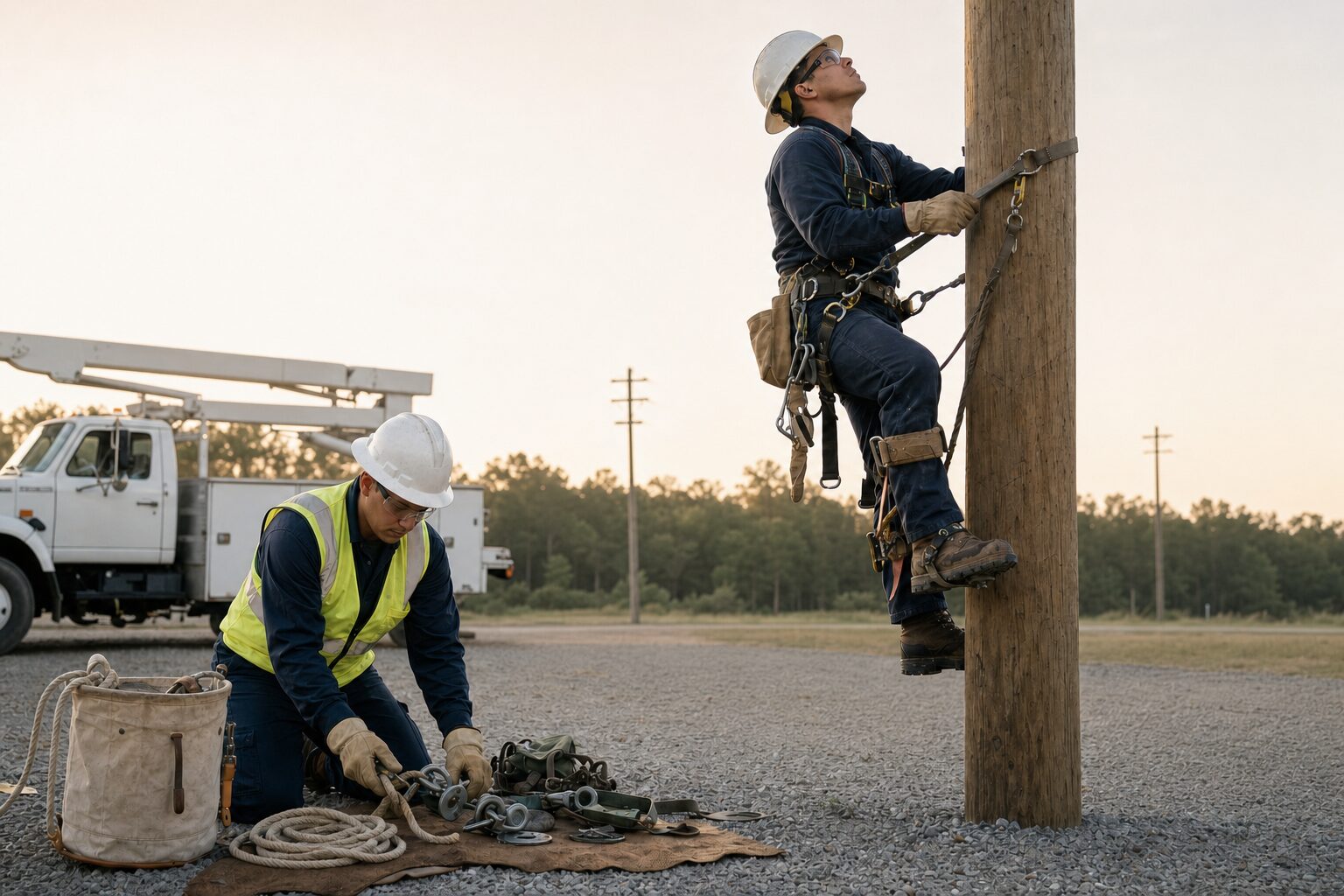
A groundman supports the crew so linework can be completed safely and efficiently. Depending on the job, that may include:
- loading, unloading, and organizing material;
- stocking and inspecting trucks;
- handling handlines, tools, and line hardware;
- framing material on the ground;
- digging, tamping, trenching, or helping set poles and anchors;
- setting up traffic control and maintaining the work area;
- pulling wire or cable under direction;
- operating vehicles or equipment when qualified; and
- watching the jobsite and communicating hazards to the crew.
The exact limits matter. Some groundmen work almost entirely with material and site preparation. Others gain broader experience around distribution, transmission, or substation crews. The title does not tell you whether you will climb, operate equipment, attend training, or become eligible to bid into an apprenticeship.
Groundman also does not always mean “future apprentice.” It can be a separate bargaining-unit classification or a long-term crew-support job. In outside construction, a groundman may obtain work through a union hiring hall while applying separately to the regional line apprenticeship.
For example, IBEW Local 602's outside-construction orientation places groundmen and truck drivers in the hiring-hall referral system, while outside apprentices report to the apprenticeship committee. Both work in the same industry, but they enter work through different systems.
What makes an apprentice different
An apprenticeship is not simply a job where someone promises to teach you.
The U.S. Department of Labor explains that apprenticeship differs from other work-based training because apprentices are paid employees, receive structured on-the-job learning and related instruction, train under mentors, and work toward a recognized credential. A Registered Apprenticeship also includes progressive wage increases and has been validated by the Department of Labor or a State Apprenticeship Agency. You can review the federal explanation of how apprenticeship differs from other training.
Lineworker apprentices gradually perform more complex work as their training and demonstrated ability allow. They also complete technical instruction and have their progress tracked. The Bureau of Labor Statistics says electrical power-line workers typically complete apprenticeships or other employer-sponsored training, and qualified apprentices generally reach journey level after three or four years.
The details still vary. An outside-line apprenticeship may dispatch apprentices among signatory contractors across a large territory. A utility may hire apprentices directly into its own progression. A cooperative or municipality may use a regional training provider while keeping the apprentice employed at one system.
Whatever the structure, you should be able to get clear answers to four questions:
- Who operates or sponsors the apprenticeship?
- How are your work hours, competencies, and instruction recorded?
- What triggers each step and wage increase?
- What credential or journey-level classification do you receive after completion?
If nobody can answer those questions, do not rely on the word “apprentice” in the job title alone.
Why groundman hours can be confusing
Groundman hours can matter without being apprentice hours.
They may help you:
- qualify for a different groundman referral book;
- document related construction experience;
- become more competitive in an apprenticeship interview;
- meet an employer's minimum experience requirement; or
- become eligible to bid on an internal apprentice opening.
That does not mean the hours shorten the apprenticeship.
IBEW Local 57's current book-signing and referral procedures, for example, use documented groundman hours to determine eligibility for Groundman Book 1. That is a hiring-hall classification rule, not a promise that those hours become apprentice credit.
An even clearer example appears in an Ameren Illinois labor agreement filed with the Illinois Commerce Commission. Its Groundman Pre-Apprentice classification is expressly intended to produce journeyman linemen and requires the employee to accept an apprentice vacancy, but the agreement also states that time in the pre-apprentice position is not included in apprentice training time.
That is why you need two separate answers:
- Does this job improve my chance of entering the apprenticeship?
- Will any of this time reduce what I must complete after I enter?
The first answer can be yes while the second is no.
Three common routes from entry level to journeyman
There is no single national hiring path. Most candidates will see some version of these three.
Route 1: Get hired directly as an apprentice
You apply to a utility, cooperative, municipality, contractor program, or joint union-contractor apprenticeship and are selected directly into the program.
This is the cleanest route because you start accumulating approved apprentice progress immediately. Direct entry does not mean easy entry. You may still need a Class A CDL, transcript, aptitude test, interview, physical assessment, travel availability, or other program-specific qualifications.
If you are ready to apply, use the lineman apprenticeship guide to build a regional program list and compare actual requirements. You can also watch current apprentice lineman jobs.
Route 2: Work as a groundman while applying to an outside-line apprenticeship
You sign the appropriate groundman books or take a contractor groundman job, gain field experience, and apply separately to the apprenticeship serving that region.
This route can teach you how crews operate, improve your material and equipment knowledge, and show whether you want the work. It may also strengthen your application. It does not guarantee selection, and the apprenticeship may still start you at its first step.
The Northwest Line JATC illustrates the separation clearly. Its outside lineman apprenticeship requirements recommend signing outside-local out-of-work books, but applicants still complete the program's application, aptitude test, interview, and ranked selection process. Once selected, the apprenticeship itself is a 7,000-hour program.
Route 3: Enter through an employer's groundman or pre-apprentice progression
Some utilities use groundman, line assistant, helper, or pre-apprentice roles to prepare employees for future apprentice openings.
This can be an excellent route when the pathway is written down. Look for a defined eligibility period, training requirements, bidding or selection rules, and an explanation of what happens if no apprentice opening becomes available.
Pay close attention to words such as eligible, may, and considered. “Eligible to apply after six months” is not the same as “promoted after six months.” Ask whether advancement is automatic, competitive, seniority-based, or dependent on vacancies.
When a groundman job is a strong next step
A groundman offer deserves serious consideration when the work is tied to electrical line crews and the terms help you move forward.
Good signs include:
- the employer can name the apprenticeship or progression you may enter;
- the posting or agreement explains how employees become eligible;
- you will work around the type of line construction you want to learn;
- the job helps you obtain or use a required CDL;
- supervisors will document your duties, training, and work history;
- you can continue applying to formal apprenticeships; and
- the pay, travel, housing, schedule, and layoff risk are workable for you.
A quality pre-apprenticeship should have more than a promising title. The Department of Labor describes quality pre-apprenticeship programs as having industry-based training and a relationship with a Registered Apprenticeship that supports entry. Its pre-apprenticeship guidance is a useful standard for judging whether a claimed bridge has substance.
The groundman job may also save you from spending money blindly. Six months on a real crew can tell you more about early starts, weather, travel, physical work, safety culture, and crew life than a stack of career videos.
Warning signs that the path may be going nowhere
Be cautious when the employer relies on vague promises instead of a written process.
Warning signs include:
- “Everyone moves up eventually,” but nobody can explain how;
- the job is called groundman but is not connected to electrical line work;
- you are told the hours count, but the apprenticeship sponsor will not confirm it;
- there is no related instruction, evaluation, or progression plan;
- promotion depends on an opening with no typical timeline;
- you must pay substantial money for training that the target apprenticeship does not recognize;
- the company asks you to perform work beyond your training or authorization; or
- the travel, residency, or layoff expectations are disclosed only after you accept.
Ask for the name of the program and contact the sponsor, training director, union hall, or employer training department yourself. A recruiter or coworker may be sincere and still misunderstand how credit or advancement works.
How to compare a groundman offer with an apprentice offer
Do not compare only the starting hourly rate. A groundman rate can be higher or lower than an early apprentice rate depending on the employer and agreement.
Compare the whole path:
Training progress
Which offer starts documented progress toward journey level now? If the groundman role is a feeder, how long do employees usually wait before entering the apprenticeship?
Recognition
What completion record will you have? Registered Apprenticeship completers can obtain a federal or state apprenticeship record through Verify My Apprenticeship. Employer programs may issue a different credential, so ask how other employers recognize it.
Work and supervision
What work will you do during the first year? Who supervises you, what tasks are allowed at each stage, and how are skills evaluated?
Pay and benefits over time
Look beyond day-one pay. Compare scheduled wage steps, overtime rules, health coverage, retirement contributions, dues or training deductions, tools, travel costs, and lodging.
Location and stability
A local utility groundman job may keep you near one service territory but make you wait for a vacancy. An outside apprenticeship may start formal training sooner but require travel across several states. Neither arrangement is automatically better; the right one depends on the written terms and what you can realistically sustain.
Questions to ask before accepting a groundman job
You do not need to interrogate the hiring manager. You do need specific answers.
Ask:
- Is this position part of an apprenticeship, a formal pre-apprenticeship, or a separate groundman classification?
- What apprenticeship or progression do groundmen move into?
- Is entry automatic, competitive, seniority-based, or dependent on an opening?
- What did the last few people in this position have to do before advancing?
- Do these work hours count as apprentice hours, related experience only, or neither?
- Will the program sponsor confirm that answer in writing?
- What training, CDL, test, residency, or performance requirements must I complete?
- What is the usual wait, and what happens if no apprentice opening appears?
- Where can I be assigned, and who pays for travel or temporary lodging?
- How will my hours, duties, and training be documented if I leave or apply elsewhere?
The most revealing question is often: “Can you show me the written progression?”
How to make groundman experience useful
If you take the job, treat it as real career evidence rather than time served.
- Keep copies of job descriptions, training records, certifications, and any documents showing hours worked.
- Maintain your driver's license, CDL, medical certification, and required safety credentials.
- Learn the material, truck setup, handlines, rigging basics, job briefings, and equipment within the limits of your role.
- Ask for feedback and become known as someone who works safely, listens, and can be trusted with the next task.
- Record specific duties for future applications instead of writing only “groundman” on your résumé.
- Continue applying to apprenticeships unless your current employer has given you a dependable written path.
Do not inflate the title. If you are a groundman, say you are a groundman and describe the relevant work accurately. Apprenticeship committees and line supervisors care more about honest, specific experience than a title made to sound bigger.
Which job should you choose?
Choose the apprentice job when it is a legitimate program, you can meet its travel and training obligations, and journey-level linework is your goal. It is the direct path.
Choose the groundman job when it gives you legitimate line-crew experience, makes financial and practical sense, and offers either a credible feeder path or a better position from which to keep applying. It can be an excellent first step without being an apprenticeship.
Walk away from either title when the safety, training, pay, or advancement promises do not hold up under basic questions.
You can compare current groundman openings, apprentice openings, and all lineman job listings, but verify every pathway with the employer or program sponsor before making a move.
The bottom line
An apprentice lineman is already on a defined training path toward journey level. A groundman may be standing next to that path, gaining useful experience, waiting for an opening, or working in a separate classification.
The difference is not how hard either person works. It is whether the job includes documented progression, related instruction, supervised skill development, and a recognized completion point.
Before you accept an offer, find out what the job starts, what the hours count toward, and what must happen next. A clear answer can save you months or years of waiting on a promotion that was never guaranteed.