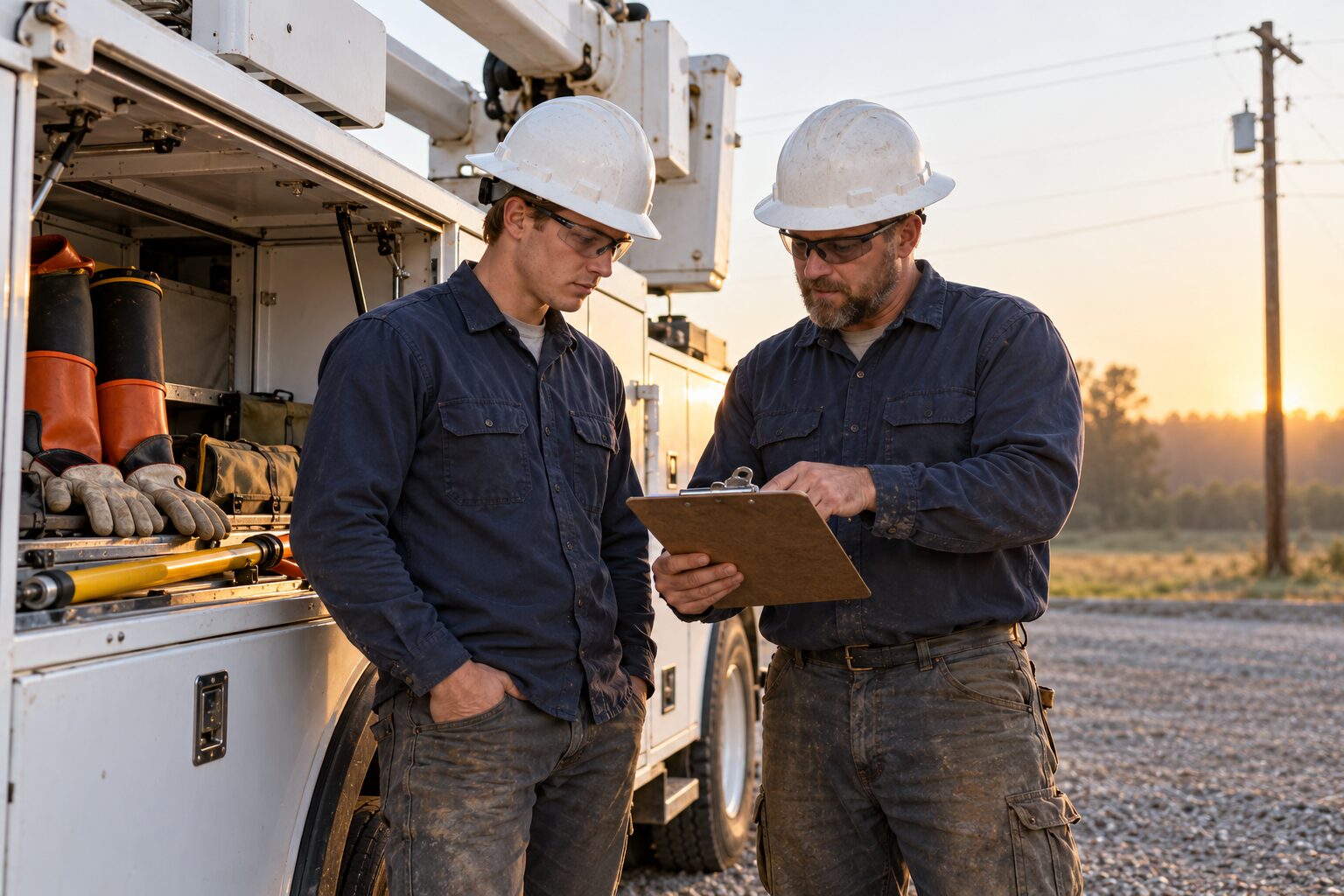
The first time somebody on a line crew says an apprentice is “hot,” it can sound like a simple promotion. Finish enough hours, move up a step, and now you are a hot apprentice.
That is close enough for a quick conversation at the show-up. It is not accurate enough to manage your apprenticeship.
Your step, the tasks you are allowed to perform, the hours your program credits as hot time, and your qualification for a specific energized task are connected. They are not interchangeable. Two apprentices with the same total hours can be under different rules because their programs, training records, work experience, employers, or current assignments are different.
If you are trying to figure out when you become hot, start with the standards and rules for your own apprenticeship. Then look at the hours your program has actually credited, not just the hours printed on your pay stubs.
The short answer
A lineman apprentice usually becomes “hot” when the apprenticeship program authorizes that apprentice to begin supervised training on energized primary lines or equipment. The exact step and requirements are set by the program, not by one national hot-apprentice rule.
For example, the California-Nevada Electrical Training Trust rules classify first through third step apprentices as cold and fourth through seventh step apprentices as hot. Its hot apprentices may work on energized parts over 600 volts under direct journeyman supervision.
The current Northwest Line Construction Industry JATC standards use a different gate. Before moving into energized work over 600 volts, an apprentice needs JATC approval, supporting progress reports, recommendations, Hot Stick training, and adequate cold-distribution experience. The standards then require minimum hot-distribution hours before advancement to sixth and seventh step.
Those are two real programs with two different structures. Neither should be treated as a rule for every utility, contractor, JATC, or state.
“Hot apprentice” and “hot time” are not the same thing
These phrases often get used as though they mean the same thing. It helps to separate them.
A hot apprentice is an apprentice whose current step and program approval allow supervised training in the program's energized-work category.
Hot time is the portion of work the program accepts and records in that category. Being assigned to a hot crew for ten hours does not automatically mean you earned ten hot hours.
Your step is the advancement period recognized by your program. A step can affect wages and permitted work, but advancement may depend on more than total hours. Programs can also require minimum time in a step, classroom progress, tests, current certifications, satisfactory field reports, and specific work-category hours.
Then there is qualified employee, which is OSHA language. That is a safety qualification tied to a person's training, knowledge, demonstrated ability, supervision, and assigned duties. It is not simply another name for a hot apprentice or a journeyman.
Keeping those four ideas separate prevents a lot of bad assumptions.
What Cal-Nev counts as hot time
Cal-Nev's published rules provide a useful example because they define both the apprentice level and the time category.
Its definition says hot time is the period when an apprentice is working on or near, within the primary zone, a circuit or apparatus energized above 600 volts for installation, removal, transfer, or maintenance. The time begins when the apprentice is positioned close enough to start that work and ends when the work is complete and the apprentice is no longer near the conductors or apparatus.
That wording matters. It does not say every hour on a job with energized primary counts.
Cal-Nev also says climbing through circuits that other workers have safely covered does not count as hot time. Working near circuits that do not need to be covered or barricaded under the applicable safety rules does not count either.
Under the same rules:
- first through third step apprentices are considered cold;
- first step apprentices may not work on energized parts, while second and third step apprentices may work on energized parts up to 600 volts under direct journeyman supervision;
- fourth through seventh step apprentices are considered hot;
- hot apprentices may work on energized parts over 600 volts only under direct supervision of a journeyman lineman;
- a hot apprentice may not work alone in a bucket while energized primary work is being performed on that structure; and
- the program's work-hour breakdown includes 1,000 hours of hot distribution involving rubber gloving and hot sticking.
That second point is easy to miss. In Cal-Nev, “cold apprentice” does not mean every cold step has the same limits or that a second or third step never works on anything energized. It means the apprentice has not reached the program's hot classification for work over 600 volts.
The program also requires monthly progress reports. Late or improperly handled reports can keep hours from counting toward a step advancement. That is a good reminder that doing the work and receiving credit for the work are two separate events.
What Northwest Line JATC counts as hot time
Northwest's current standards show why an apprentice cannot safely borrow another program's answer.
Before an apprentice advances to hot work above 600 volts, Northwest requires program approval. Its published standards list supporting on-the-job progress reports, a recommendation from the current or recent foreman and journeyman, successful completion of Hot Stick training, and 750 to 1,000 hours of cold distribution experience.
Northwest defines countable hot hours as time when a hot apprentice is actively participating in energized work over 600 volts. Its definition includes job-site preparation for that hot work, such as the pre-job tailboard and getting the needed tools and PPE ready before the hands-on portion begins.
It specifically excludes driving to and from the job site or between job sites.
The standards also allow certain active wire-stringing work on an energized conductor replacement job, such as operating the puller or tensioner, to be recorded as energized work. They say this work should not make up a significant portion of the apprentice's energized-work record and indicate that more than 100 hours would be significant.
Northwest requires direct journeyman supervision during hot work. The foreman or journeyman must sign the hot-work section of the monthly progress report and add useful comments. The program requires at least 100 hot-distribution hours before advancement to sixth step and at least 500 before advancement to seventh step.
Notice the difference between the two programs. Cal-Nev starts and stops hot time based on the apprentice's proximity to the energized apparatus. Northwest expressly includes certain preparation at the job site. That is exactly why the correct answer has to come from your own current program documents.
A long shift may produce only a few hot hours
Imagine a 12-hour shift that includes driving, material handling, a tailboard, setting up tools and PPE, a period of hands-on energized work, and cleanup. It would be a mistake to enter 12 hot hours simply because the crew performed hot work that day.
How much counts depends on the program. Northwest includes certain job-site preparation tied to the hot work, but excludes travel to or between job sites. Cal-Nev uses the period when the apprentice is positioned in proximity to begin the qualifying work until the work is finished and the apprentice leaves that proximity. The right number comes from the written definition and what actually happened, not the length of the shift or the name of the crew.
What usually does not count
There is no universal list, but these are common reasons a paid hour might not become a credited hot hour:
- The line or equipment was deenergized and grounded.
- You were on the crew but were not actively involved in the energized work.
- You were observing from outside the work area.
- You were driving to the job, hauling material between sites, or waiting away from the energized-work operation.
- You were performing ordinary ground work that belongs in another training category.
- Your current step was not authorized for the task.
- The work did not meet your program's voltage, proximity, or task definition.
- The required direct supervision was not present.
- The hours were entered under the wrong category or the report lacked a required signature.
- The program did not accept the report because it was late, incomplete, or inconsistent with the employer's record.
None of that means the work was useless. Cold distribution, transmission, underground, substation, equipment operation, and ground work all build skills that matter. It only means the hour belongs where the program says it belongs.
OSHA does not give you a blanket “hot” card
The word “hot” is common trade and apprenticeship language. OSHA's federal electric-power standards use different terms.
OSHA has closely aligned federal rules for this work. 29 CFR 1910.269 covers qualifying operation and maintenance work, while 29 CFR 1926 Subpart V covers construction of electric power transmission and distribution lines and equipment, including alteration and improvement work. The exact standard that applies depends on the work being performed, not whether the crew casually calls itself a construction or maintenance crew.
Under both sets of rules, only qualified employees may work on or with exposed energized lines or parts of equipment. OSHA defines a qualified employee as someone knowledgeable about the construction and operation of the equipment involved and its associated hazards. The required training includes recognizing exposed live parts, determining nominal voltage, understanding minimum approach distances, and using the necessary protective methods and equipment. The construction requirements appear in 1926.950, 1926.960, and the qualified-employee definition in 1926.968.
The definition is task-specific. OSHA notes that an employee in on-the-job training can be considered qualified for duties the employee has demonstrated an ability to perform safely at that level of training while under the direct supervision of a qualified person. OSHA's questions and answers for the electric-power standards also explain that trainees remain under direct supervision until they demonstrate proficiency in the work practices involved.
In plain language, moving into your program's hot steps does not make you qualified for every energized task on every system. The employer still has to verify your training and demonstrated ability for the work you are assigned. Voltage, construction method, minimum approach distance, rubber-glove rules, live-line-tool rules, equipment, and employer procedures all matter.
A crew nickname is not an authorization. A pay step is not an authorization. A previous employer's signoff is not automatic authorization at a new employer.
Who decides what
On many crews, the apprenticeship program, employer, foreman, and supervising journeyman are all involved. Their roles can overlap, especially in a utility-run program, but they are answering different questions.
- The apprenticeship sponsor or JATC decides whether you meet its step requirements, whether reported hours fit its categories, and whether those hours are credited toward advancement or completion.
- The employer decides whether your training and demonstrated proficiency qualify you for the specific work assignment under the safety rules and the employer's procedures.
- The foreman and supervising journeyman control and supervise the work in the field and may verify your progress report. Their signature documents what happened, but it does not let them waive a program requirement or an employer safety rule.
If somebody tells you that you are “hot,” ask one follow-up question: “Hot for which tasks, under whose approval, and how should I report the time?” That usually clears up the ambiguity before it turns into a safety or advancement problem.
Why an apprentice can reach the right step and still be short on hot time
Sometimes the problem is paperwork. Often it is the work that happens to be available.
A contractor may spend months on transmission, underground, or deenergized rebuild work. A utility crew may have energized tasks, but not enough journeymen, equipment, or suitable conditions to put an apprentice into that work safely. Storm restoration can create long shifts without creating the exact training experience your program requires. Seasonal work, outages, customer requirements, crew rotations, and apprentice-to-journeyworker ratios can all affect exposure.
Your own readiness matters too. A program or employer may hold back energized assignments until required classes, tests, certifications, field evaluations, or cold-distribution hours are complete. A foreman may also need to see consistent habits before recommending the next training level: solid cover-up, careful tool handling, clear communication, correct job briefings, and the ability to stop when something does not look right.
That is not the same as saying an apprentice should quietly accept an unexplained delay. It means you should find out which requirement is actually missing.
How to keep your hot hours from disappearing
Do not wait until the end of a step to discover that your record and your memory disagree.
Keep your own running log
Record the date, employer, crew, location, general task, voltage class, work method, your role, and the journeyman or foreman who supervised the work. Do not put sensitive system details in a personal cloud document or take job-site photos against company policy. You need enough information to reconcile the official report, not a private copy of the utility's operating record.
Review the category before the report is due
Ask the foreman how the work should be categorized while the job is still fresh. “Was today hot distribution under our program's definition?” is easier to answer than “What did we do three weeks ago?”
Save what your program allows you to save
Keep copies or confirmation receipts for submitted reports when the rules permit it. Retain pay stubs and employer time records long enough to resolve a discrepancy. Remember that payroll hours prove you were paid for time. They do not prove the program credited that time to a particular training category.
Check credited hours, not only submitted hours
A submitted report can be returned, rejected, reclassified, or held for a missing signature. Use the apprentice portal or ask the training office what has actually posted to your record.
Never round hot time up
If the definition says hot time stops when you leave the primary zone, do not report the rest of the shift because the crew continued working nearby. Both Northwest and Cal-Nev treat accurate progress reporting seriously. Inflating the number can become a disciplinary problem, not a harmless correction.
What to ask when your hot time is stalled
Go to the training director or apprenticeship office with a specific question. “I need more hot time” is understandable, but it does not show which requirement or record needs attention.
Bring your current credited-hour summary and ask:
- What step and written approval must I have before hot time can be credited?
- What voltage, tasks, work methods, and preparation time fit this program's definition?
- How many hot hours are required before my next step and before completion?
- Am I currently short on hot hours, cold-distribution hours, classroom work, tests, time in step, or a field recommendation?
- Which submitted hours have not been credited, and why?
- Who must sign or verify the hot-work entry?
- Does the program rotate apprentices when the current assignment cannot provide required experience?
- If suitable work is unavailable, what is the normal process and expected timeline?
Then talk with your foreman. Keep the conversation practical. Ask what skills you need to demonstrate to be trusted with the next supervised task and whether appropriate work is expected on the current project.
Do not ask a crew to manufacture energized exposure just so you can fill a category. Training follows safe work that needs to be done. It does not create a reason to keep equipment energized.
Questions to ask before choosing an apprenticeship
Hot-time rules are worth checking before you accept a program, especially if two offers look similar.
Ask the apprenticeship office for the current standards, rules, and work-process schedule. Find the sections covering step advancement, energized work, direct supervision, progress reports, and rotations. Then ask how the program handles apprentices who are meeting every requirement but are assigned to work that cannot provide a required category.
Useful questions include:
- At which step can supervised energized-primary training begin?
- What must be completed before that step?
- How does the program define a hot hour?
- How many energized-work hours are required at later steps or before completion?
- How are hours verified and corrected?
- Does the program move apprentices between employers or crews to balance experience?
- Who makes the final decision that an apprentice is ready?
This is one part of evaluating a program. Our guide to becoming a lineman apprentice covers entry routes and basic qualifications. The honest timeline to journey level explains why completing the stated number of hours can take longer than simple calendar math suggests.
Common hot-time misunderstandings
“I am fourth step, so I am hot everywhere”
No. Fourth step is hot under Cal-Nev's published rules. Northwest uses JATC approval, training, recommendations, progress reports, and cold-distribution experience as its gate. Your step number only means what your own program says it means.
“If I am in the bucket, the whole shift is hot time”
Not necessarily. The task, voltage, proximity, participation, supervision, and program definition determine the category. Bucket time by itself is not the test.
“If the line is covered, it counts as deenergized”
No. Cover-up is a protective method. It does not deenergize a line. Whether a particular period counts as hot time still depends on the program's definition and what the apprentice is doing.
“Hot time means I can work energized primary alone”
No. The two program examples in this article both require direct journeyman supervision. Cal-Nev expressly says a hot apprentice may not work solo in a bucket while energized primary work is being performed on that structure.
“My pay stub proves my hot hours”
It proves paid time. Your apprenticeship record determines credited training categories. Reconcile both records before a missing signature or incorrect category becomes an advancement problem.
The bottom line
An apprentice becomes hot when the apprentice's own program says the required step, training, experience, recommendations, and approval are in place. Hot time counts when the work fits that program's written definition and is reported and verified correctly.
Do not chase a number without understanding the category. Read your standards, keep your records current, ask what is actually missing, and treat direct supervision as part of the training rather than something you are supposed to outgrow early.
The goal is not to collect energized hours as fast as possible. The goal is to become the person who can perform the work safely, explain the hazards clearly, and earn the next responsibility for the right reasons. If you are still early in the program, the apprentice probation guide explains the habits and paperwork that can matter long before hot work begins. For a wider view of the trade's risks and controls, read how dangerous linework is.