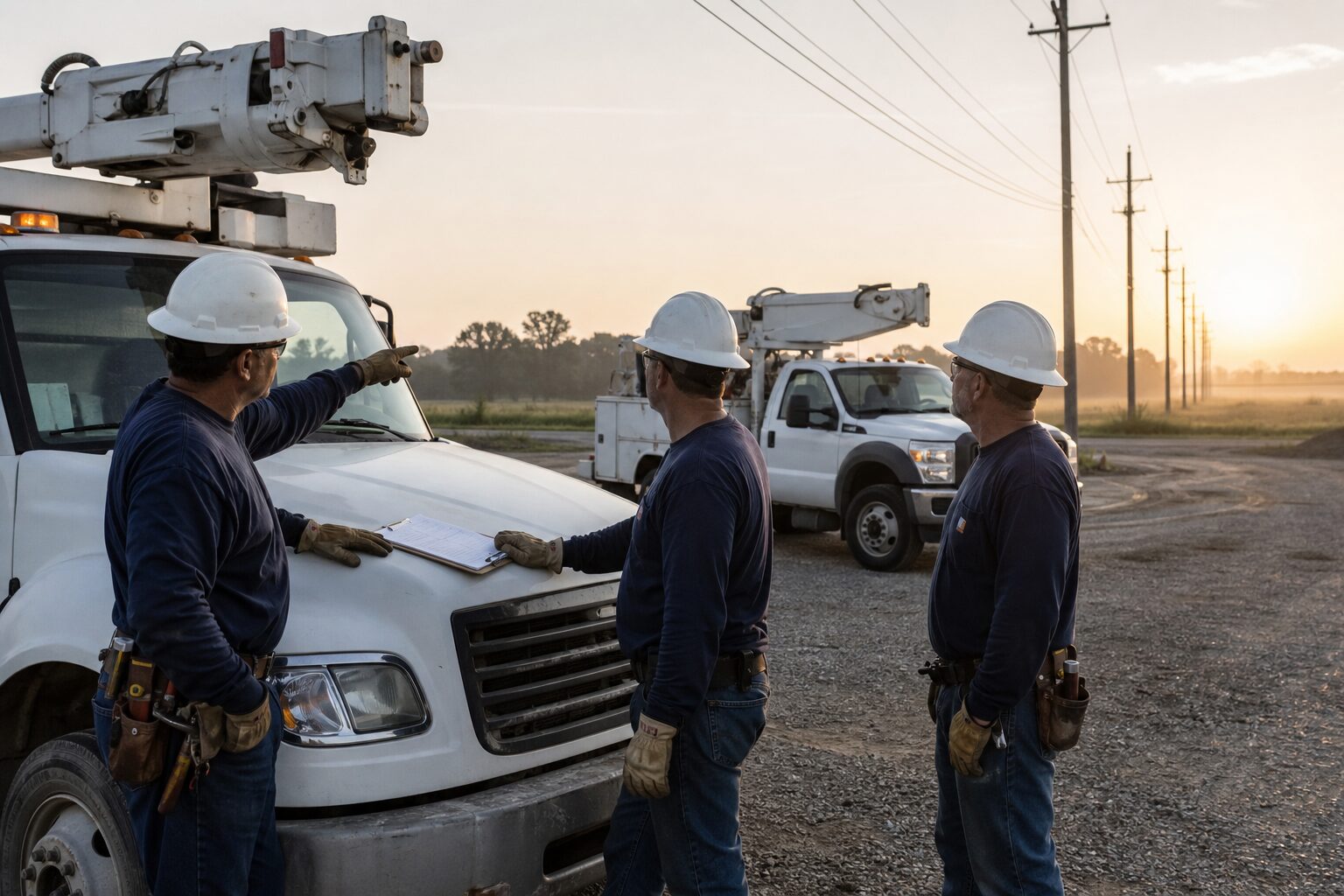
Linework is dangerous. That is the honest answer.
It is also incomplete. A national fatality rate cannot tell you whether the crew you are about to join plans its work well, whether questionable equipment gets pulled from service, or whether a supervisor will back a worker who calls a stop.
Those details matter. So does the federal data. Used together, they give you a much better picture than either “the job is safe if you follow the rules” or “you could die any day.” This article explains what the latest number says, what it cannot say, and how to use it when judging a linework job.
The short answer
The latest complete federal data available when this article was published cover 2024. BLS released the national 2024 census in February 2026. Its fatal injury chart reports:
- 21 fatal work injuries among electrical power-line installers and repairers;
- a fatal injury rate of 13.8 deaths per 100,000 full-time equivalent workers; and
- an all-worker fatal injury rate of 3.3 per 100,000 full-time equivalent workers.
Put plainly, the reported lineworker rate was a little more than four times the rate for all workers in 2024.
That makes linework a high-risk occupation. It does not mean that 13.8 out of every 100,000 individual linemen will die each year, and it does not give you a personal probability of dying on the job. It is an occupation-wide comparison based on hours worked. Your exposure on a given day depends on the work, the system, the crew, the weather, the schedule, and the controls being used.
What the BLS number actually measures
The BLS figure comes from the Census of Fatal Occupational Injuries, usually called CFOI. The program checks multiple records, including death certificates, workers' compensation records, and government reports, to identify and verify work-related fatal injuries. Its official definition covers deaths caused by traumatic injuries at work.
That distinction matters. The count is not a measure of every way a career can affect health. It does not capture the sore shoulders, damaged knees, hearing loss, nonfatal heat illness, close calls, or other nonfatal injuries that can shape a lineworker's career.
The rate is expressed per 100,000 full-time equivalent workers. According to the BLS fatal injury rate methodology, the agency divides fatal injuries in an occupation by total hours worked, then multiplies the result by 200 million. That represents 100,000 full-time workers working 40 hours a week for 50 weeks.
The hours estimate comes from the Current Population Survey, which is a sample. BLS warns that sampling error can be larger in smaller occupational groups. It also notes that workers are classified by their primary job in the hours estimate, even when a worker who died was performing another job. The rate is designed for national occupational comparisons, but it is not precise enough to treat the decimal point as a personal risk score.
The count gives the rate important context. It represents 21 workers, 21 families, and crews that had to keep going afterward. At the same time, a relatively small annual count and a sampled hours estimate can make the rate move noticeably from one year to the next. One published year does not establish a trend.
There is one more limit worth knowing. The occupation is electrical power-line installers and repairers. It is not the telecommunications lineworker category. It also does not provide separate rates for apprentices, journeymen, foremen, utility employees, contractors, distribution crews, transmission crews, or storm hands. The published number combines many kinds of electrical linework into one national figure.
What the 2024 number does not prove
The 2024 figure tells us that the occupation's fatal injury rate was substantially higher than the rate for all workers. It does not tell us:
- whether linework is getting safer or more dangerous over time;
- which event types caused the 21 deaths;
- whether utilities or contractors had a higher rate;
- what share occurred during storm restoration;
- how experience, crew size, shift length, voltage, or work method affected the outcome; or
- whether one employer is safer than another.
Answering those questions requires more detailed data than the headline rate provides. If someone uses this one number to make a claim about a particular company, type of crew, or recent trend, ask what additional evidence supports it.
Do not let a ranking do the thinking for you
Articles about the “most dangerous jobs” often turn a serious subject into a countdown. Those lists can be misleading.
Some lists use fatality rates. Others use total deaths. Some mix broad occupational groups with narrowly defined jobs. A small occupation can have a high rate with a modest count, while a large occupation can have many deaths and a lower rate. BLS itself says there is no universal definition of a “dangerous job,” and the chart cited above shows selected occupations rather than a complete ranking of every job in America.
The useful conclusion is simpler: linework has a substantially higher fatal injury rate than work overall. You do not need a dramatic ranking to take that seriously.
Why linework can turn unforgiving so quickly
Most jobs have hazards. Linework combines several hazards that can become lethal with little room for correction.
Electrical energy
Contact is not the only electrical danger. An unexpected source, backfeed, induced voltage, a failed assumption about system status, or entering the minimum approach distance without the required protection can put a worker in the path of hazardous energy.
The regulatory details depend on the work. Operation and maintenance of electric power generation, transmission, and distribution installations are generally covered by OSHA 1910.269. Construction work on transmission and distribution lines and equipment is generally covered by OSHA's Subpart V rules, including the deenergizing requirements in 1926.961.
Across those rules, “deenergized” has a specific meaning tied to required protective steps. Opening a device or being told a line is dead is not enough by itself.
Do not use an article as a field procedure. The employer's energy-control, testing, grounding, clearance, and work-practice rules, applied by qualified people to the actual system, have to govern the job.
Falls and work at height
Lineworkers climb poles and structures and work from aerial devices. A fall can begin with a positioning mistake, equipment problem, electrical contact, changing weather, or a task that puts the worker outside a stable working position.
Fall protection is not a box to check after the electrical plan is finished. It is part of the plan from setup through completion.
Traffic, vehicles, and heavy equipment
The pole may be beside a highway, on a narrow shoulder, behind a guardrail, or down an access road that barely supports a loaded truck. Crews also work around digger derricks, cranes, trailers, suspended loads, winches, and moving equipment.
The danger is not confined to the person in the bucket. A ground worker can be exposed to traffic, shifting material, equipment swing, rigging, unstable ground, and the public entering the work area.
Weather, fatigue, and changing conditions
Storm work brings wind, darkness, damaged structures, tangled conductors, long shifts, unfamiliar systems, and pressure to restore service. Ordinary work can still involve heat, cold, lightning, rain, rough terrain, and hours on the road.
Fatigue matters because it changes attention, communication, reaction time, and judgment at the same time the work may be getting more complex. NIOSH's current fatigue guidance connects fatigue with extended hours, nonstandard schedules, demanding work, stress, and heat. “We have always pushed through” is not a fatigue plan.
Confined spaces, fire, strain, and the physical toll
Underground work can add vaults, manholes, atmospheric hazards, difficult access, and rescue complications. The work can also involve fire and explosion hazards, heavy material, awkward positions, repetitive force, and injuries that do not make a fatality chart.
OSHA's electric power industry hazard overview identifies electrocution, falls, confined spaces, fires and explosions, sprains, strains and fractures, and environmental stress as major hazard categories. BLS also describes lineworkers as facing high voltage, height, weather, physical demands, confined spaces, and long hours during storm response in its Occupational Outlook Handbook.
One national number cannot describe every linework job
The national number combines workers doing very different jobs under very different systems.
A planned maintenance job on a familiar circuit is not the same exposure as storm restoration at night. A crew with verified system information, qualified workers, the right equipment, and time to work through changes is not in the same position as a short-handed crew improvising around a work package that no longer matches the field.
Employer type alone does not settle the question. A utility can have a strong safety system or a weak one. So can a contractor. Look at how the employer plans work, trains people, controls energy, maintains equipment, staffs crews, manages fatigue, learns from close calls, and responds when someone says the plan no longer fits the field.
If you are deciding between the two paths, the utility and line contractor comparison explains the differences in work control, travel, pace, and employment structure. Use those differences as questions to investigate, not assumptions about which side is automatically safer.
What a functioning safety system looks like on the crew
A safety program should show up in ordinary work. You should be able to see it in the way a job is prepared, briefed, performed, and changed.
For work covered by 1910.269, OSHA's job briefing rule requires the employee in charge to cover hazards, procedures, special precautions, energy-source controls, and personal protective equipment before each job. The construction rule in 1926.952 has parallel requirements. Both call for another briefing when significant changes introduce hazards that were not covered.
On a good crew, the briefing is a working conversation, not a signature. People can describe the sequence, name the hazards and controls, ask what happens if a condition changes, and identify who has the next decision. The newest apprentice can ask a basic question without being treated like a problem.
You should also see these habits:
- assignments match each worker's training and demonstrated proficiency;
- trucks, tools, protective equipment, and rescue equipment are inspected and available;
- system information and field conditions are compared before work starts;
- host utility and contractor information reaches the people doing the work;
- unexpected conditions cause a pause and a new decision;
- near misses and equipment problems are reported without hiding the facts;
- supervisors can explain who has authority to stop affected work;
- production pressure does not erase required controls; and
- lessons from an incident reach the crews that need them.
The information handoff matters on contractor work. Both 1910.269 and 1926.950 require host and contract employers to share relevant system and hazard information and coordinate work rules. A rule on paper does not help the groundman or bucket operator if the information never reaches the crew.
None of these habits makes linework harmless. They do show whether the company backs its safety program with day-to-day decisions.
If you already work in the trade, use the data this way
The national rate is most useful as a reason to examine the work in front of you. It is not a substitute for a hazard assessment, job briefing, or your employer's procedures.
Pay attention to the gap between the written program and field behavior:
- Does the briefing change when the circuit information, weather, traffic setup, pole condition, or work method changes?
- Can the crew explain which tasks each apprentice is qualified to perform today?
- Does a new-to-the-company journeyman have to demonstrate proficiency before being turned loose on unfamiliar work practices?
- Does questionable equipment leave service, even when the schedule is tight?
- Do high-potential close calls produce a change that reaches other crews?
- During storm work, does the plan cover sleep, travel, handoffs, and the drive back, or only production hours?
You may not control the company program, but you can notice whether the controls named in the briefing are present in the field. If they are not, use the employer's stop-work and reporting process before the exposure continues.
Questions to ask before accepting a linework job
You probably will not receive incident files during an interview, and one polished answer does not prove much. Ask for concrete examples. When possible, ask a current crew member the same questions and compare the answers.
- What safety and field training happens before a new employee joins a crew?
- How are apprentices assigned work and supervised as they progress?
- How does the employer establish and verify that someone is qualified and proficient for a task?
- How are job briefings handled when the plan or field conditions change?
- What is the stop-work process if any crew member sees a hazard?
- How are near misses reported, reviewed, and shared with other crews?
- Who can remove a truck, tool, or protective device from service?
- How does the company manage long shifts, storm rotations, lodging, and travel fatigue?
- What first-aid and rescue skills does the crew practice, and how often?
- On contractor work, how does host utility information reach the crew before the job starts?
- What did the company change after its most recent serious incident or high-potential near miss?
The last question is especially useful. A credible answer does not need names or graphic details. It should identify what changed and how the change reached the field. “That worker broke a rule” is not a complete answer if no one examined planning, supervision, equipment, system information, or working conditions.
If you are applying for your first apprenticeship, also read the guide to becoming a lineman apprentice. A recognized training path gives you structure, but you still need to understand how the employer and the specific crew develop new workers.
Red flags that deserve a second look
No employer is perfect, and workers can make poor decisions inside a good program. What you are looking for is the pattern.
Be cautious when:
- safety questions are answered with “use common sense” instead of a process;
- new workers are expected to learn unfamiliar work by watching once;
- the crew ridicules people who pause a job or ask for clarification;
- supervisors describe near-miss reporting as creating trouble;
- broken or questionable equipment stays in service because the job is behind;
- job briefings are signatures without a shared plan;
- the company cannot explain how qualifications and proficiency are established;
- storm schedules are discussed only in terms of hours and money; or
- every serious event is blamed on one careless worker without examining planning, supervision, equipment, or conditions.
A tough culture and a careless culture are not the same thing. Lineworkers can be direct, demanding, and proud of hard work while still insisting on clear plans and verified controls.
What this means if you are new to the trade
The fatality rate is a reason to choose your training and employer carefully. It is not a reason to pretend that a beginner can personally control every risk.
Your job as a new apprentice is to stay inside your training, listen closely, ask when you do not understand, and speak when the field does not match what was briefed. Do not fake familiarity to avoid looking green. The crew already knows you are new. A confident guess around hazardous energy is far more dangerous than an honest question.
Learn who is in charge, who holds the clearance when one is required, what work you are qualified to perform, and how the employer expects you to stop and report a concern. Watch what experienced workers do when the plan changes. Their response will tell you more about the culture than a safety poster.
As you gain experience, your responsibility grows. The line foreman guide explains how planning, job briefings, crew assignments, and stop-work decisions change when you take the crew.
If the data makes you reconsider linework
That is a reasonable reaction. Twenty-one deaths are not an abstraction to the families and crews affected by them.
You do not have to talk yourself out of concern to prove you belong in the trade. Use the concern to ask better questions. Visit the training site. Talk to current apprentices and journeymen without a recruiter present. Ask what happens when field conditions change, after someone reports a close call, or when a worker says they are too tired to continue safely.
Then decide whether the work, training, and employer fit the level of risk you are willing to accept. Someone else being comfortable with that tradeoff does not make it the right choice for you.
The practical bottom line
The latest BLS data show that electrical power-line installers and repairers had a fatal injury rate of 13.8 per 100,000 full-time equivalent workers in 2024, compared with 3.3 for all workers. The occupation recorded 21 fatal work injuries.
That is clear evidence that linework carries serious risk. It is not proof that every linework job is equally dangerous, and it is not a personal prediction.
The useful response is not denial or panic. Learn what the number means. Look past the employer's safety slogan. Ask how work is planned, how qualifications are established, how energy is controlled, how fatigue is managed, and what happens when a crew member calls a stop.
Linework never becomes low-consequence work. A strong training program, a prepared crew, and an employer that backs safe decisions are what keep a hazardous trade from becoming a reckless one.