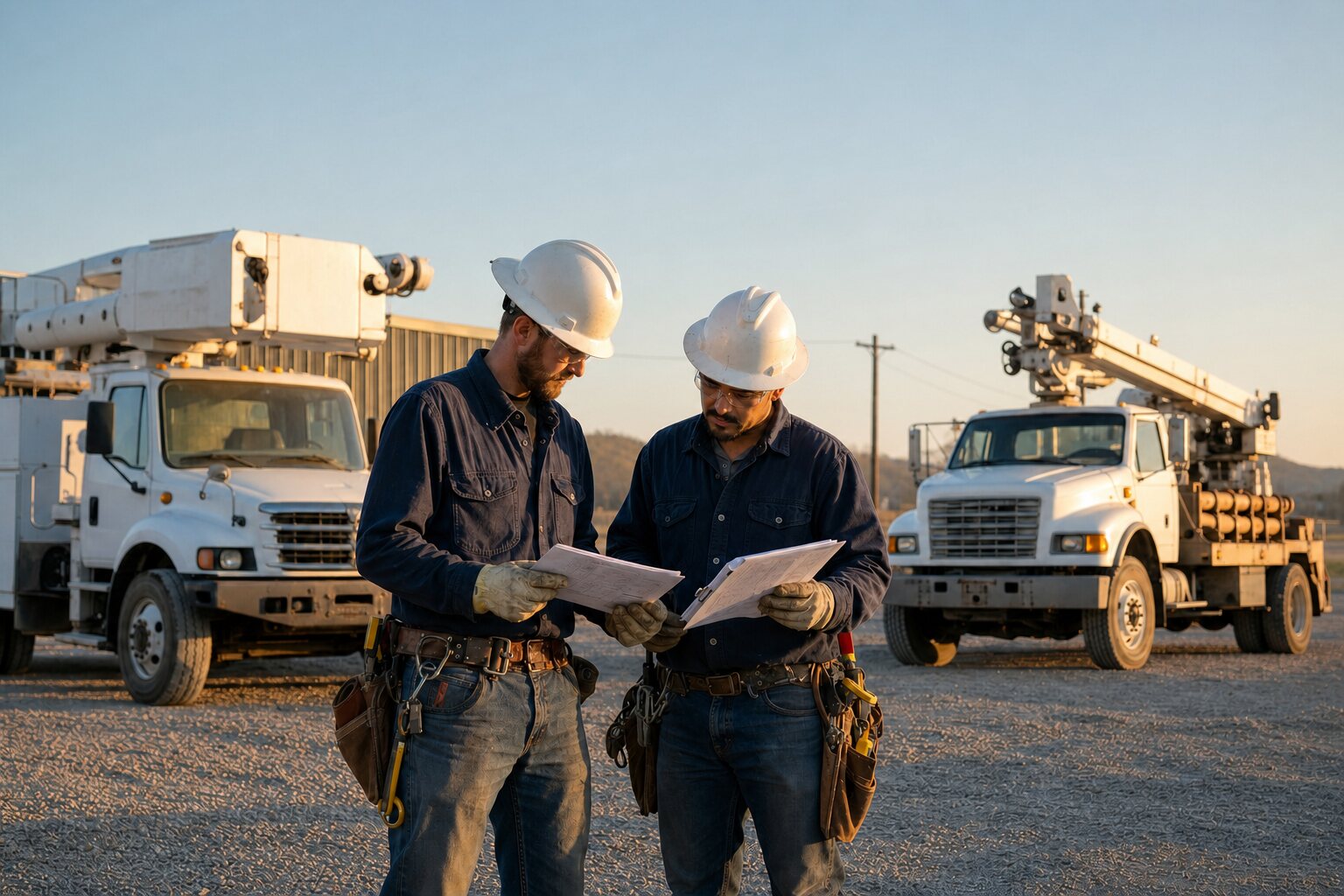
Two job postings can both say "lineworker" and still describe very different lives.
One job may put you on a utility crew that reports to the same service center, maintains one electric system, and takes a rotating callout schedule. The other may put you on a contractor crew at a project show-up, with the possibility of moving when that job is finished.
That difference affects more than travel. It affects who controls your assignment, how your apprenticeship hours are recorded, what happens when work slows down, and how much of your paycheck may go toward fuel, hotels, or a camper site.
Here is the point people often miss: utility versus contractor is not the same as union versus nonunion. Many utility crews are represented by the IBEW. Line contractors can be union or nonunion. Ask about the employer and the labor agreement as two separate things.
Before you accept either offer, get clear answers about the show-up, territory, schedule, training program, pay rules, and what happens after the current work ends. Those details matter more than the label on the truck.
The short answer
A utility lineworker is employed by the organization that owns or operates the electric system. That employer may be an investor-owned utility, electric cooperative, municipality, public utility district, or government agency. You usually work within that employer's territory, staffing system, and operating rules.
A contractor lineworker is employed by a company hired to build, rebuild, maintain, or restore someone else's system. Your assignment may depend on a project, a customer contract, a regional outside-line agreement, a union referral, or an apprenticeship committee.
Neither description tells you everything.
- A utility job may keep you near one service center, or it may require travel across several states.
- A contractor job may move every few months, or it may stay on one long project for years.
- A utility may offer a registered apprenticeship with a portable credential, or it may use an internal progression that other employers evaluate differently.
- A contractor may offer broad training through a joint apprenticeship, or it may hire for one narrow type of work.
- Either workforce may be union or nonunion.
Do not ask which side is better in general. Ask which offer gives you the better training path, working conditions, and home life after you account for the details.
Utility lineman vs. line contractor at a glance
Who employs you? A utility lineworker is employed by the system owner or operator. A contractor lineworker is employed by a construction or service company performing work for a utility or another customer.
Who decides where you work? At a utility, the employer assigns you within its service territory and operating structure. At a contractor, the employer, project needs, collective bargaining agreement, hiring hall, or apprenticeship committee may affect the assignment.
Is utility work always local? No. A local distribution utility may have a compact territory, but a statewide, regional, or federal utility can require substantial travel. Emergency restoration can also send utility crews away from their normal headquarters.
Do contractors always travel? No. Some contractor crews remain near one show-up for a long project. Others follow transmission, distribution, underground, substation, or storm work across a wide area.
Which side offers broader training? It depends on the program and available work. A regional outside-line apprenticeship may rotate an apprentice among contractors and work types. A utility apprenticeship may provide deep experience on one system and may rotate employees among districts or departments.
Which side is more stable? A regular utility position may offer more continuity than a short contractor call. That does not make every utility job secure or every contractor job temporary. Ask whether the position is regular, temporary, or project-based, then ask what happened to the last crew when similar work ended.
Which side pays more? The higher hourly rate is not always the better deal. Overtime rules, double time, standby pay, per diem, lodging, retirement contributions, health premiums, paid leave, and travel costs can easily change the comparison.
Start with the employer, not the stereotype
The Bureau of Labor Statistics reports that utilities employed 50 percent of electrical power-line installers and repairers in 2025, while utility system construction employed another 29 percent. Local government, specialty trade contractors, and the federal government employed most of the remainder.
Those categories describe who employs the worker. They do not create universal job descriptions.
In this guide, utility means an organization that owns or operates an electric system and employs its own lineworkers. Line contractor means a company performing electrical line construction, maintenance, or restoration for a utility or another system owner.
The physical work can overlap. Both sides may set poles, install conductor, maintain equipment, work overhead or underground, respond after storms, and operate heavy equipment. OSHA standard 1910.269 applies to electric power generation, transmission, and distribution work. The name on your paycheck does not change the hazards or the employer's safety duties.
What working directly for a utility can mean
A utility workforce can belong to several kinds of employers:
- an investor-owned electric utility;
- a rural electric cooperative;
- a municipal utility or public power department;
- a public utility district or authority;
- a state or federal power organization; or
- another system owner with an internal line department.
Do not assume that utility means nonunion. The IBEW Utility Department represents workers at investor-owned utilities, cooperatives, municipalities, and government-owned utilities. A utility offer should tell you whether the position is in a bargaining unit and which agreement controls its wages and working conditions.
Utility lineworkers commonly maintain and restore the employer's own system. Depending on the organization, that can include distribution trouble work, new services, system upgrades, streetlights, underground cable, substations, transmission, inspections, and storm response.
Working on one system lets you learn its construction standards, switching procedures, equipment, geography, and operating practices in depth. The tradeoff is that your department may cover only part of the system. A large utility may keep transmission, distribution, underground, trouble, service, and substation work in separate groups.
The territory may also be larger than the word "utility" suggests. The Bonneville Power Administration's lineworker apprenticeship, for example, rotates apprentices among crews across a multistate transmission service territory and tells applicants that travel and possible relocation are important parts of the career.
Before you count on being home every night, ask for the normal headquarters, the full service territory, the callout rotation, and any rules about temporary assignments or relocation.
What working for a line contractor can mean
A line contractor performs work for a utility, government agency, developer, or another customer. One contractor may focus on overhead distribution. Another may build transmission, underground distribution, substations, or renewable-energy connections. Large contractors may do several of those.
On the union outside-construction side, the worker may also deal with a local hiring hall and a regional joint apprenticeship program. The contractor is the employer, but the apprenticeship committee can control apprentice placement, progress, and reassignment.
The Missouri Valley Line Constructors apprenticeship FAQ says most apprentices work for more than one contractor to gain varied training, cannot choose their contractor, and may be assigned anywhere in the program's seven-state jurisdiction. Northwest Line JATC similarly requires apprentices to work throughout its multistate jurisdiction and states that apprentices are responsible for their own travel expenses.
That structure can give an apprentice experience with different crews, customers, systems, and types of construction. It can also put the next show-up hundreds of miles from home. You may have to find lodging quickly, pay the first week's costs before receiving a paycheck, and move again when the assignment changes.
Contract work is not automatically short. A large rebuild or transmission project can last years. It is also not automatically broad. A worker can spend a long time doing one type of construction if that is where the employer has work.
Ask two questions separately: How long is this project expected to last? What does the company normally do with employees when a project ends? A recruiter may answer the first question without answering the second.
The differences that matter most
Work territory and travel
The city in a job posting is not always where you will start each morning. It may be a permanent service center, a regional office, a temporary show-up, or simply the place where the company handles hiring.
For a utility offer, ask:
- What is the normal headquarters or service center?
- How large is the service territory?
- Can employees be temporarily assigned to another district?
- Is relocation part of the apprenticeship?
- How often do mutual-assistance or storm assignments take crews away from home?
For a contractor offer, ask:
- Is the posted location the actual show-up?
- How long is the current project expected to last?
- What is the full jurisdiction or travel area?
- Can the employer move the crew to another customer or state?
- Who pays for lodging, travel days, mileage, or a camper site?
The BLS notes that crews maintaining the interstate power grid may travel throughout a region, while local utility workers often maintain equipment in a defined area. Emergency work can also require travel and long hours after storms.
Put the actual show-up on a map before you accept. Ask whether drive time starts at your home, the service center, the hotel, or the job site. An unpaid 90-minute drive each way adds 15 hours to a five-day week. If overnight travel is possible, price a real hotel, camper site, fuel, and meals in that area before treating per diem as extra income.
Apprenticeship structure and recognition
If you are entering the trade, the apprenticeship structure may matter more than the starting rate.
A utility may employ and train apprentices through its own program, a labor-management program, a community college partnership, or another training provider. A contractor apprenticeship may be operated by one employer or by a regional joint committee that assigns apprentices among participating contractors.
Ask for the exact program name and sponsor. Do not settle for "we will get you into the apprenticeship later." Verify:
- whether you will be formally registered or indentured;
- who records your work hours or competencies;
- what related instruction you must complete;
- what triggers wage and step increases;
- what happens if the employer or project runs out of work; and
- what certificate, ticket, or journey-level classification you receive at completion.
Registered Apprenticeship combines paid work, mentorship, progressive wages, classroom instruction, and a nationally recognized credential. A job title by itself proves none of those things.
Call the program sponsor before your start date. Ask whether the employer participates, when your registration begins, and who receives your work-hour reports. That five-minute call can prevent months of work that does not advance you the way you expected.
Use the lineman apprenticeship guide to compare program requirements before you accept. If you are considering a helper or groundman position instead, read the groundman versus apprentice guide and confirm whether the job starts formal apprentice progress.
Work assignments and control
A utility employee generally works within the employer's departments and bidding or progression rules. Seniority, qualifications, open positions, management assignments, or the labor agreement may control when you can move to another crew.
A contractor journeyman may have more ability to choose which calls to take, especially through a hiring hall. An apprentice usually has much less control. Current ALBAT lineman policies, for example, state that apprentice assignments are made by the applicable assignment office and that apprentices who are laid off must report for reassignment.
Before accepting an apprenticeship, be honest about whether you can follow its assignments for several years. Ask how much notice apprentices usually receive before a move, whether you can be sent anywhere in the jurisdiction, and what happens if you refuse an assignment. Do not assume you can quit one contractor or transfer programs without affecting your standing.
Type and variety of linework
Utility work may give you deep operating experience on the employer's system. That can include troubleshooting, switching, routine maintenance, customer outages, callouts, and storm restoration in addition to construction.
Contract work may provide more exposure to new construction, rebuilds, large transmission projects, underground installation, or different customer standards. It may also be production-focused and tied closely to project schedules.
Those are common patterns, not guarantees. A utility transmission department may travel widely and build major structures. A distribution contractor may work the same local system for years.
Ask the supervisor what the crew completed during the last twelve months. Then ask what the last new hire did during the first 90 days. The second answer is often more useful because it tells you what you are likely to do, not everything the department is capable of doing.
Schedule, callouts, and storm work
Ask about the normal week and the week when everything goes wrong.
A utility position may include standby, trouble calls, residency requirements, emergency response, rotating shifts, or mandatory overtime. A contractor position may follow project hours, a collective bargaining agreement, customer outage windows, or storm rosters.
Ask for specifics:
- Is the normal schedule five eights, four tens, rotating shifts, or something else?
- How is overtime assigned?
- Is there a callout or standby rotation?
- What rest rules apply after an overnight call?
- Is storm travel mandatory?
- Are travel time, meals, lodging, and per diem paid?
- How frequently did the crew work nights, weekends, or storms during the last year?
The phrase "plenty of overtime" is not a schedule. Ask how many overtime hours the crew worked in the last month, how many weekends they worked in the last year, and which written policy controls the pay. Do not build your household budget around storm overtime that may not happen.
Layoffs, reassignment, and bidding
A regular utility role usually keeps you employed by one organization when a particular project finishes. Work may shift to maintenance, another district, or another department. Still, check whether the offer is regular, probationary, temporary, seasonal, or tied to a specific opening. Those words matter.
Contractor employment follows the contractor's available work. When a job ends, the employer may transfer the crew, lay workers off, or return union workers to the referral system. Apprentices may report back to their program for reassignment rather than choosing the next employer themselves.
Ask two separate questions:
- What normally happens to this crew when the current work ends?
- What happens to my apprenticeship, health coverage, and retirement contributions during a layoff or reassignment?
You need both answers. A quick reassignment may keep your apprenticeship moving. A layoff may affect health eligibility, retirement contributions, and the timing of your next wage step even if your completed hours stay on record.
Pay and benefits
Do not compare the two offers by hourly rate alone.
Build the comparison from:
- straight-time hourly pay;
- scheduled apprentice increases;
- daily and weekly overtime rules;
- double-time conditions;
- standby and callout pay;
- storm rates;
- per diem and lodging;
- paid or unpaid travel time;
- health premiums and eligibility;
- retirement contributions and vesting;
- paid leave and holidays;
- union dues or training deductions;
- required tools, boots, CDL costs, and certifications; and
- the cost of maintaining a second household or traveling home.
A contractor offer with a higher scale can lose ground if you pay for lodging and frequent trips home. A utility offer with a lower hourly rate may include paid leave, lower health premiums, or a retirement plan that matters more over time. The reverse can also be true when an outside agreement provides strong employer-paid health and retirement contributions.
Use a normal week for the comparison, not the biggest storm check anyone mentions. Calculate straight time and the overtime you can reasonably expect. Subtract weekly housing, fuel, tolls, camper fees, and employee health premiums. Then compare paid leave and retirement separately, because those benefits will not appear in your take-home pay.
Ask for the wage sheet, benefit summary, travel policy, and apprentice progression schedule. If the recruiter cannot provide them, call the union hall, apprenticeship office, or benefits administrator that can.
Use the lineman salary guide for the national wage picture, but use the actual offer, agreement, and benefit documents for your decision. Federal wage estimates do not include every premium, and they cannot tell you what one employer will put in your check.
When a utility offer may be the stronger choice
A utility offer may fit you better when:
- the headquarters and service territory fit your family obligations;
- the apprenticeship starts promptly and has a recognized completion credential;
- the employer can show a clear wage and progression schedule;
- you want operating, trouble, maintenance, or customer-restoration experience on one system;
- the callout and storm obligations are workable;
- the benefits and retirement rules support a long stay; and
- the position is regular rather than temporary, seasonal, or dependent on a future vacancy.
Slow down if the utility talks about stability but cannot tell you when apprenticeship training begins, what credential you earn, or how often the crew is called out. A groundman or helper job with a chance to bid later is not the same as an apprenticeship that starts on day one.
When a contractor offer may be the stronger choice
A contractor offer may fit you better when:
- it starts a legitimate apprenticeship now instead of promising one later;
- the program provides documented training across several work types;
- you can meet the jurisdiction's travel requirements;
- the wage, overtime, per diem, and benefits still work after travel costs;
- the program has a clear process for layoffs and reassignment;
- you want exposure to different systems, customers, or major construction; and
- the resulting journey-level credential supports where you want to work later.
Travel by itself does not make a contractor offer bad. The problem is accepting without a clear show-up, a workable housing plan, confirmed apprentice status, a system for recording your hours, or an explanation of what happens after the current project.
Red flags on either side
Slow down when you hear:
- "You will probably become an apprentice later," with no written progression;
- "Everyone here makes six figures," with no schedule or pay rules;
- "The job is local," but nobody defines the territory;
- "Travel is paid," but nobody explains what counts as travel time;
- "You will be a journeyman when you finish," but nobody names the credential;
- "There is always work," but nobody explains the current project or reassignment process;
- "The union takes care of everything," without naming the local or agreement; or
- "Safety training happens on the job," while you are being asked to perform work beyond your qualifications.
Turn every promise into something you can check: a program name, a reporting address, a start date, a wage sheet, or a written policy.
Questions to ask before accepting the offer
Use the same questions for both employers. Send the important ones by email so you have the answers when it is time to compare.
- What classification will appear on my first paycheck?
- Is this a regular position, a temporary position, or a job tied to one project?
- Where do I report on a normal morning, and can that location change?
- What is the full territory or jurisdiction where I can be assigned?
- How many nights did this crew spend away from home during the last year?
- Who pays for travel time, mileage, lodging, meals, and per diem?
- What schedule, callout rotation, storm duty, and overtime rules apply?
- If this is an apprenticeship, who sponsors it and when am I officially registered?
- How are my hours, classes, wage steps, and completed work types recorded?
- What happens to my job, apprenticeship, and benefits when this project ends or work slows down?
- Which union local and agreement cover the position, if any?
- Can I review the wage sheet, benefit summary, progression rules, and travel policy before I accept?
Do not rely on one recruiter for every answer. Call the union local about the agreement. Call the apprenticeship sponsor about registration and assignments. Ask the benefits office about eligibility and vesting. Ask the hiring manager or crew supervisor about the actual show-up and recent schedule.
Compare the next three years, not the next paycheck
Put both offers on one sheet of paper. Compare where each one leaves you after the first year and at the end of the apprenticeship.
For each offer, record:
- your official classification on day one;
- the date formal apprentice progress begins;
- expected out-of-pocket travel and tool costs;
- the territory you must be willing to cover;
- the work types you are likely to learn;
- the written wage steps;
- the completion credential;
- what happens when work slows; and
- whether the arrangement is sustainable for your household.
An immediate contractor apprenticeship may be a better career move than a utility groundman job that only makes you eligible to bid later. A registered utility apprenticeship near home may be the better choice if the contractor's travel costs would keep your household under strain for several years. A journey-level worker may care more about ticket recognition, benefit portability, and control over calls than either entry-level concern.
The better offer is the one you can complete, afford, and live with.
Which offer should you choose?
Choose the utility offer if its territory, training, callout schedule, benefits, and long-term work fit the life you want. Choose the contractor offer if its apprenticeship, work variety, compensation, and assignment system give you a stronger path into the trade.
Do not reject a union utility because you think all union linework comes through contractors. Do not reject a contractor because someone told you every outside job keeps you on the road. There are too many exceptions for either shortcut to be useful.
Before you say yes, make sure you know three things without guessing: when your training starts, where the employer can send you, and what happens when the current work changes.
You can compare current apprentice lineman jobs, journeyman lineman jobs, and all linework openings. Read each posting for the employer type, location language, travel requirements, and progression details, then verify the important terms with the employer, union, or apprenticeship sponsor.
The bottom line
A utility job puts you on the system owner's payroll. A contractor job puts you on the payroll of a company whose work comes from projects and customer contracts. Either path can provide excellent training and a long career. Either path can also go badly when the location, apprentice status, pay rules, or future work are left vague.
Get the important answers in writing. Run the real numbers after travel and housing. Call the union or apprenticeship sponsor yourself. Then choose the offer you can stick with long enough to become the lineworker you want to be.