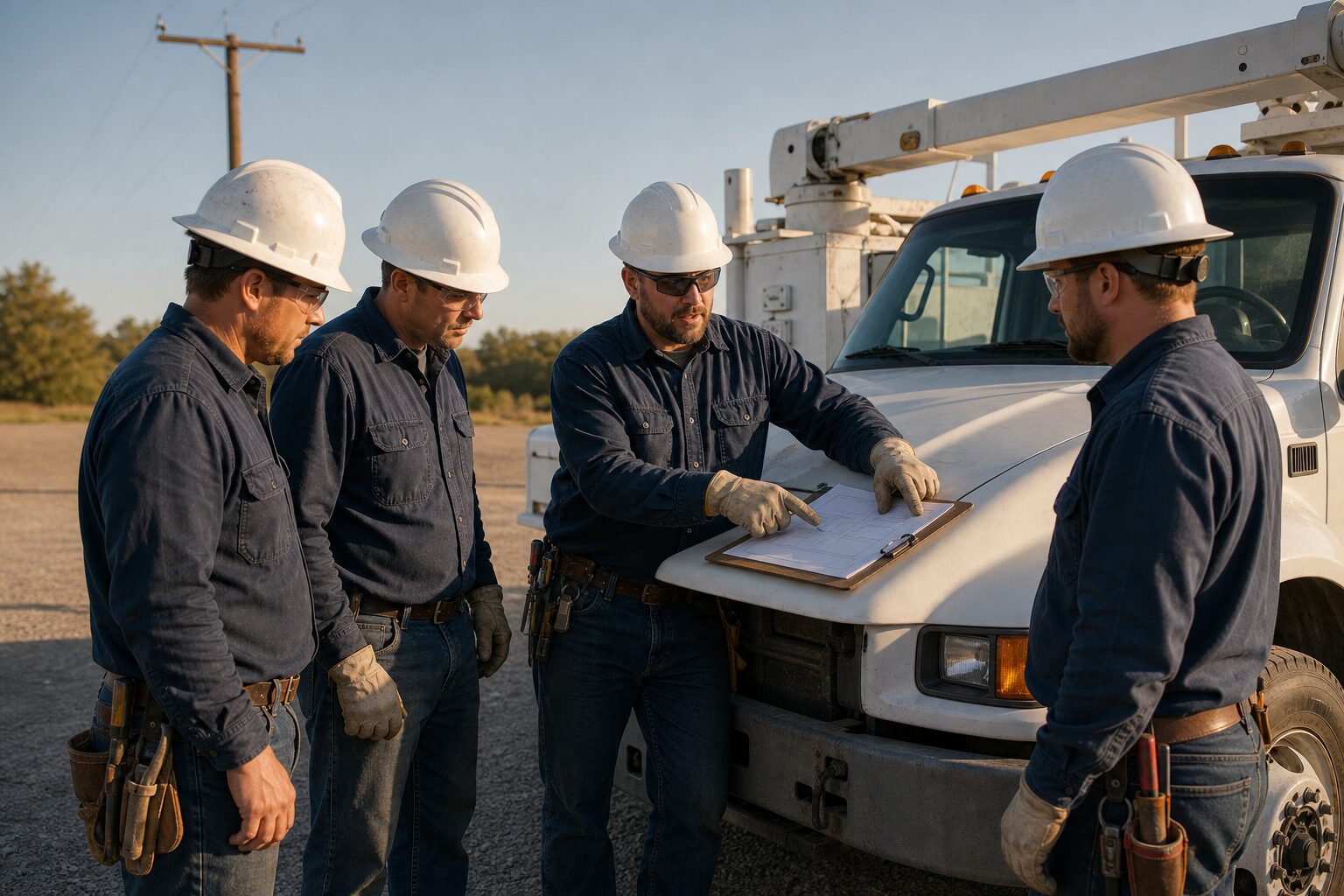
The first morning you take a crew can feel familiar right up until everyone turns toward you for the plan.
You may know the circuit. You may have worked with the same people for years. You may even be the strongest hand on the crew. None of that changes the fact that the job now reaches you differently. The schedule, the switching, the briefing, the apprentice who is not ready for a certain task, the missing material, and the decision to stop when the field does not match the print all land on your side of the pickup hood.
That is the real promotion. A foreman does not simply perform linework at a higher pay rate. A foreman turns a work order into a safe, workable plan and keeps the crew aligned when the plan has to change.
This guide is for journeymen considering a working foreman, line foreman, or crew leader role. Titles and authority vary among utilities, contractors, union agreements, and operating procedures, so use your employer's rules as the final word. The goal here is to show you what to examine before you say yes.
It is not a switching, grounding, or clearance procedure. Those steps have to come from the rules and training for the employer and system where you are working.
The short answer
You are probably ready to become a line foreman when you can do more than complete the work yourself. You need to be able to:
- explain the entire job in a way the crew can act on;
- recognize what is missing before work starts;
- assign people according to their qualifications and current ability;
- run a real job briefing, not just read a card;
- understand the clearance and energy-control responsibilities assigned to you;
- change the plan without losing control of the crew;
- correct unsafe or weak performance directly;
- document time, material, training, and problems accurately; and
- stop the job when conditions no longer match the plan.
If your main reason for wanting the position is that you are tired of taking direction, you are probably focused on the wrong part of the job. Foremen have to reconcile information and requirements from operations, supervision, engineering, customers, general foremen, and system operators. Their skill is turning all of that into one clear plan for the people in the field.
Taking the crew does not make you the whole safety program
The promotion gives you more authority and more assigned responsibility. It does not transfer every employer duty onto one person in a hard hat.
OSHA's summary of employer responsibilities says employers must provide a safe workplace, comply with applicable standards, examine workplace conditions, provide safe tools and equipment, establish operating procedures, and train employees. The foreman works inside that system. You cannot personally replace missing training, an unqualified crew, defective equipment, or information the employer never provided.
The rest of the crew does not stop owning its part either. Every crew member still has to follow the work practices that apply to the assignment, stay within their training and qualifications, and raise concerns. OSHA's worker-participation guidance recommends giving every worker a way to report hazards and initiate or request a temporary shutdown of work believed to be unsafe.
What changes for you is that you can no longer notice a gap and assume someone above you will catch it. Name the missing resource or decision, stop the affected work, and move the problem to the person who can fix it.
First, find out what the title actually means
"Foreman" is not one universal job.
A working foreman may lead a small crew while still climbing, operating equipment, and performing linework. A line foreman may spend more time planning, coordinating, checking the work, and handling records. A general foreman may coordinate several crews and foremen. Some employers use "lead lineworker" or "crew leader" for work that another employer assigns to a foreman.
The title also does not automatically tell you who is in charge of the job or who holds a clearance. Federal OSHA generally addresses operations and maintenance work on electric-power systems in 29 CFR 1910.269. Construction work on those systems falls under 29 CFR 1926 Subpart V. Both sets of rules use the term "employee in charge" and require the employer to designate one crew employee to be in charge of a clearance when lines or equipment are being deenergized for employee protection.
OSHA's electric-power questions and answers make the title point directly: the employee in charge must control the work but does not need any particular job title. The person leading the briefing and the person holding the clearance may be you, but do not assume either assignment from the word "foreman" alone.
Before accepting a promotion, ask what authority comes with it:
- Are you the employee in charge on every job, or only when specifically assigned?
- Will you request, hold, transfer, and release clearances?
- Can you change crew assignments or the work sequence?
- What is the stop-work process, and can you pause affected work immediately?
- Who handles switching orders, customer coordination, traffic control, and locates?
- Are you accountable for apprentices on the crew?
- Who signs time, material, inspection, and incident records?
Get answers from the written job description, operating manual, safety rules, and labor agreement. Do not build your understanding from the way one foreman happens to run one crew.
Your first job is to build a plan the crew can execute
As a journeyman, you can sometimes receive an assignment and quickly see your piece of it. As foreman, you have to see all of it.
Start with the work order, print, staking sheet, switching plan, or customer request. Then compare that paperwork with the actual field conditions. Identify the circuit and voltage, sources of energy, required clearances, grounding or equipotential-zone requirements, the minimum approach distances established by the employer, traffic exposure, public exposure, equipment setup, material, qualifications, rescue plan, and likely points where the job could change.
The employer is required to give the employee in charge available information about existing system characteristics and conditions related to the job. The parallel requirements appear in 1910.269(c) and 1926.952. That matters because a good field plan cannot be built from a work order number and a vague promise that the crew will figure it out.
Then turn that information into a sequence. Who is doing what? What must be complete before the next step starts? Where will trucks and grounds be placed? Who is watching traffic or the public? Which tasks can an apprentice perform, and under what supervision? What condition requires everyone to stop and regroup?
Public utility job descriptions show how broad this responsibility can be. The City of Cuyahoga Falls line foreman specification, for example, includes planning and scheduling work, training and directing employees, obtaining supplies and equipment, enforcing safety rules, and keeping work, time, material, and safety records. The exact duties will differ at your employer, but the pattern is familiar: the crew needs labor, equipment, information, and coordination before it can produce safe work.
If the print does not match the pole, the material is wrong, or the crew lacks a required qualification, that is not a problem to quietly work around. It is a reason to correct the plan.
Use the same five checks through the day
Every employer has its own forms and procedures, but a new foreman benefits from a repeatable rhythm.
- Before the trucks roll: Confirm the work package, crew roster and qualifications, material, equipment, expected system status, communications, and any coordination that must already be complete.
- When you reach the site: Compare the print with the field. Look at access, structure condition, traffic and public exposure, equipment setup, environmental conditions, and anything that could change the planned sequence.
- Before work starts: Conduct the required briefing, make assignments, confirm the energy controls and clearance status that apply, and make sure the crew knows where the work stops.
- When something changes: Pause the affected work. Decide whether the change needs a new plan, another briefing, different material, more qualified help, or a call to operations or supervision.
- Before releasing protection or leaving: Follow the employer's exact accounting and release procedure. Then close the work order, time, material, apprentice, equipment, and field-condition records while the details are still fresh.
This is not a substitute for the employer's procedure. It is a way to keep the administrative pieces from falling away when the physical work gets busy.
A job briefing is not a speech
A weak tailboard sounds like one person talking while everyone else waits to sign. A useful job briefing makes the plan visible to the whole crew.
The job-briefing rules in 1910.269(c) and 1926.952 require the employee in charge to cover at least the job hazards, work procedures, special precautions, energy-source controls, and personal protective equipment. If the day's work is repetitive and similar, one briefing before the first job of the shift can satisfy the federal rule. A significant change that might affect employee safety requires another briefing before the changed work continues.
The amount of detail should fit the job and crew. The federal rules allow a brief discussion for routine work when trained, experienced employees can reasonably be expected to recognize and avoid the hazards. Complicated or particularly hazardous work, unfamiliar work, or a crew that cannot be expected to recognize the hazards needs a more extensive discussion. OSHA's job-briefing best-practices guide reinforces that distinction.
That means the foreman should do more than announce the assignment. Walk through the sequence and ask the crew to test it.
- What is different about this structure or circuit?
- Where could someone enter the minimum approach distance?
- What other source, backfeed, induced voltage, or stored energy must be controlled?
- What happens if the customer, traffic, weather, or equipment changes?
- Who has the clearance, and who is covered by it?
- Where is the rescue equipment, and who can perform the rescue?
- What is the stop condition?
The quiet apprentice and the veteran journeyman both need room to speak. The apprentice may notice a ground condition from the setup area. The journeyman may know that a drawing does not match a previous rebuild. A foreman who treats questions as resistance teaches the crew to keep useful information to itself.
The briefing is finished when the crew understands the plan, not when the form is signed.
Federal OSHA's job-briefing provisions do not themselves require a written or signed briefing record, as OSHA explained when it adopted the current construction rule. Your employer, customer, state-plan rules, or labor agreement still may. Complete the required form, but do not mistake the signature for proof that everyone understood the work.
Clearance responsibility changes the weight of every word
If the employer designates you to hold the clearance, you are taking responsibility for more than a tag or radio call.
You need to know exactly which lines and equipment are covered, what has been opened or isolated, what tags and grounds are required, who is working under the clearance, and what must happen before it can be transferred or released. For operations and maintenance work covered by federal OSHA, the sequence appears in 1910.269(m). Construction work uses the closely aligned requirements in 1926.961. Under both, lines and equipment deenergized by some other method must still be treated as energized.
OSHA's deenergizing guidance helps explain the federal sequence, but it is not your switching manual. The host utility and your employer may use different names for clearances, hold orders, tags, permits, or authorities. Follow the terminology and repeat-back requirements for the system you are actually on.
Never let the crew guess whether it is covered. Never assume another crew is clear because its truck is gone. Under the federal clearance-release sequence, the employee in charge must notify every employee under the clearance that it is about to be released, ensure those employees are clear, ensure the protective grounds protecting them have been removed, report that information to the system operator, and then release the clearance. The employer's procedure may add more steps. It may not be replaced with a head count from the cab.
The foreman also has to resist casual language. "It should be dead" is not a clearance. "They are finished over there" is not an accounting of workers. Precise words matter because other people will act on them.
If your new role includes clearances or work practices you have not performed before, do not accept them alone on confidence. OSHA requires employers to train employees for their assignments and ensure they demonstrate proficiency in the work practices involved. Ask how proficiency will be established and documented, then get the training and supervised experience the role requires.
You manage production without trading away the margin
Crews are expected to produce. Outages have windows. Customers are waiting. Contractors have schedules. Utilities have service commitments. A good foreman does not ignore production pressure. A good foreman controls it.
That starts with honest planning. If the job requires a second qualified employee, another truck, different material, traffic control, or a longer outage, say so before the crew is committed. If rain, heat, fatigue, poor access, or a system change removes the margin you planned around, stop and reassess.
The dangerous version of production pressure is usually not a supervisor openly ordering someone to work unsafely. It is a series of small compromises: skipping part of the briefing, letting an apprentice work beyond today's ability, setting a truck in a poor position to save time, or continuing after the job has become different from the one that was briefed.
Your crew watches which compromises you accept. If you reward speed but never preparation, they will learn what you really value.
You become the handoff between the office and the field
The work package begins somewhere outside the crew. Engineering may have designed it. Operations may have written the switching. A planner may have ordered material. A customer or general contractor may control access. None of those people has the same view from the right of way that your crew has.
The foreman connects the two worlds.
When field conditions differ from the plan, report the difference clearly. Include the pole or structure number, circuit, location, drawing reference, actual condition, work completed, work stopped, and what decision or material is needed. A vague message such as "the job is messed up" creates another round of questions. A clear field report lets someone solve the problem.
The same applies to coordination. Confirm outage windows, switching boundaries, inspection requirements, customer notifications, traffic control, environmental limits, and access before they stop the crew. On contractor work, understand who may direct your employees and who may only describe the customer's desired result.
If you are moving from a utility to a contractor, or the other way around, the utility and line contractor comparison explains why the reporting lines, territory, and work control can feel different even when the physical linework looks familiar.
The paperwork is part of the work
Many strong lineworkers are surprised by how much of a foreman's day happens after the last tool is put away.
Depending on the employer, you may record:
- employee time and overtime;
- units completed and work-order progress;
- material used, returned, or damaged;
- vehicle and equipment inspections;
- job briefings and changes to the plan;
- apprentice hours, tasks, and performance;
- near misses, injuries, property damage, or public contacts;
- switching, grounds, and clearance information; and
- delays, extra work, or field changes that affect cost.
Accurate records protect the crew as well as the company. Write facts while they are fresh. Identify what happened, where it happened, who was involved, what condition changed, what action the crew took, and who was notified. Do not turn a near-miss report into a character judgment. Do not change the record to make production look better.
Timekeeping deserves the same care. People notice quickly when a foreman is loose with their hours but exact about the company's material. Learn the pay rules and record the work consistently.
Leading the crew is different from being the best hand
The person who can frame a pole fastest is not automatically the person who can lead four different workers through a difficult day.
Foremen have to set expectations, make assignments, listen, teach, correct, and follow up. That includes conversations you may have avoided as a peer. If a worker is rushing, unprepared, late, distracted, or performing outside the plan, address the behavior promptly and specifically. Explain what must change and why. Correct immediate hazards in the moment. Handle the longer conversation privately when possible.
The words do not need to sound managerial. They need to leave no doubt about what happens next. Useful phrases are often plain:
- "Stop. The job changed. Let's reset."
- "I don't know yet. Hold here while I verify it."
- "Tell me what you are seeing."
- "Here is the standard, and here is what needs to change."
Saying "I don't know" is not surrendering the crew. Guessing when the crew needs a verified answer is. A steady foreman can pause the work, get the right person on the phone, and return with a clear direction without turning uncertainty into a performance.
You also have to use experience without surrendering the crew. A veteran journeyman may know the system better than you. Ask for that knowledge. Let qualified people own parts of the plan. But do not let the most forceful personality become the unofficial foreman while you carry the title and responsibility.
Apprentice development is another part of crew leadership. Give an apprentice work that fits the program step, demonstrated ability, and required supervision. Explain the standard before judging the result. Record useful feedback, not just "needs improvement." A crew that never gives apprentices room to perform will not build journeymen. A crew that gives them responsibility before they are ready is not training them either.
The Bureau of Labor Statistics notes that experienced line installers may advance into supervisory or training roles. The promotion is based on more than years in the trade. You are being trusted to make other people's work clearer and safer.
What employers usually look for before promotion
There is no national rule requiring a fixed number of journeyman years before becoming a foreman. Employers and agreements set their own qualifications.
Public job specifications show the difference. Cowlitz PUD requires a current journeyman who worked the previous five years as a journeyman, with that requirement tied to its collective bargaining agreement. Cuyahoga Falls asks for considerable experience at the Lineman A or journeyman level but does not publish a fixed year count. Treat both as employer examples, not a portable national rule.
Most will care about some combination of:
- journey-level experience in the work the crew performs;
- knowledge of construction standards and safe work practices;
- switching, tagging, grounding, and clearance competence for the assignment;
- the ability to read drawings, maps, specifications, and work orders;
- sound decisions when conditions change;
- communication with operations, customers, contractors, and crew members;
- a record of teaching apprentices and less-experienced workers;
- accurate documentation and timekeeping;
- commercial driving and equipment qualifications; and
- willingness to enforce a standard with friends as well as new hires.
The Cowlitz specification also describes the foreman as responsible for planning, organizing, and directing a crew while applying substantial knowledge of the trade, operating procedures, and safety rules. That combination matters. Technical knowledge gets the plan started. Judgment and communication keep it under control.
The pay premium may be smaller than the responsibility
Foreman pay varies widely. It may be a separate wage classification, a percentage above journeyman scale, a temporary upgrade, or a daily premium only while you are assigned to lead. The position may also change how overtime, standby, storm work, per diem, retirement contributions, and paid travel are calculated.
Before saying yes, ask for the actual wage sheet, job description, and labor agreement if one applies. Then work through these points:
- Is the rate permanent, temporary, hourly, salaried, or percentage-based?
- Does the position stay in the bargaining unit, and which agreement covers it?
- If you later step down, what happens to your seniority, classification, and bidding rights?
- Is overtime calculated on the foreman rate? If the job is salaried, how are long shifts, callouts, and storm work handled?
- Do you receive the foreman rate for travel, training, standby, and paid leave?
- Does the premium count toward retirement or pension contributions?
- Are you expected to take a company truck home, meet a residency rule, or answer calls outside scheduled hours?
- How are after-hours preparation, phone calls, and paperwork recorded and paid?
- What happens to the rate when the crew is reduced, combined, or temporarily reassigned?
- Are per diem, lodging, and travel rules different for foremen?
Compare the ordinary week, not the biggest storm check. If the role involves road work, use the per diem, lodging, and travel pay guide to calculate what the package is actually worth after assignment costs.
Money matters, but so does control. A small premium is a poor trade if you are expected to own the outcome without the authority, staffing, information, or training needed to run the job.
Questions to ask before you take the crew
Have this conversation before the start date, not during the first problem job.
- What is the exact scope of the foreman's authority?
- Is this a working or nonworking foreman position?
- What size crew and kinds of work will I lead?
- Will I supervise apprentices, and what records am I responsible for?
- Will I evaluate crew members or recommend discipline or promotions, and what process applies?
- Which clearances, switching, or grounding responsibilities come with the role?
- What formal foreman or supervisory training is provided?
- Who approves changes when the field does not match the work package?
- Am I responsible for estimating, material, inspections, or customer communication?
- What reports are due daily, weekly, and after an incident?
- How are overtime, callouts, standby, storm assignments, travel, and per diem handled?
- Is the promotion permanent, probationary, or a temporary upgrade?
- Who covers the crew when I am off, and who do I call when I need help?
- Will I receive a formal handoff on the crew, open work, equipment issues, and unfinished reports?
Ask a current foreman what takes the most time that is not listed in the job description. Then ask what problem surprised that person during the first six months. Those answers often reveal the real job.
Ask for a real handoff before day one
Taking an established crew is not the same as starting with a blank sheet. Before the first morning, sit down with the outgoing foreman or your supervisor and review the work already in motion. Ask about unfinished work orders, known field problems, promised outage dates, missing material, truck and tool defects, inspection items, and reports that still need to be closed. Confirm the crew roster, each worker's qualifications, apprentice steps and current training needs, planned absences, callout rotation, and any customer or contractor commitments the crew has already made.
Then clarify your decision limits. Which changes can you make in the field? Which ones need a general foreman, superintendent, system operator, engineering, safety, or the customer? Who needs to hear about a delay, damaged equipment, a crew conflict, or a work package that does not match the system? Save those names and numbers before you need them.
On the first day, tell the crew what you know, what you are still verifying, and what you expect from them when something does not look right. Ask what recurring problems make their work harder. You may hear about a material shortage, a trouble spot on the system, or an apprentice who needs more time on a task. Listen before changing routines simply to prove that you are in charge. Keep the practices that work, fix the gaps you can verify, and explain changes before expecting people to follow them.
A proper handoff does not make you responsible for decisions made before your promotion. It gives you the information needed to stop old problems from becoming today's surprise.
How to prepare before an opening posts
You do not need to wait for a foreman vacancy to practice the underlying skills.
Volunteer to lead a portion of the job briefing when your employer allows it. Learn how the work package is assembled. Read the construction standards that apply to the crew's common jobs. Follow a material request from the yard to the work order. Practice giving a concise field update with the exact location, condition, action, and request.
Ask a respected foreman to review how you would sequence an upcoming job. Do not only ask whether your plan is correct. Ask what you failed to consider. Learn the employer's rules for stopping work, reporting a near miss, holding a clearance, coaching an apprentice, and documenting a field change.
If formal supervisory or foreman training is available, take it. The OSHA Electrical Transmission and Distribution Partnership reports using a 20-hour Safety Leadership in Action program designed for foremen and general foremen. That does not make one specific course a universal hiring requirement. It shows that experienced industry employers, labor representatives, and OSHA have treated field leadership as a skill worth training, not something a journeyman automatically absorbs with a new title.
Finally, practice being clear without acting bigger than the crew. The best foremen do not need to win every conversation. They need the crew to understand the plan and speak up before a problem becomes an incident.
Signs you may want more time before saying yes
Waiting is not failure. It may be the safer career decision if:
- you know the physical work but not the employer's clearance or operating procedures;
- you avoid correcting friends or more-senior coworkers;
- you see briefings and records as obstacles rather than controls;
- you are already exhausted by callouts or travel;
- you cannot explain the reason behind your work sequence;
- you tend to keep going after the job changes because stopping feels embarrassing;
- the employer will not define your authority or provide required training; or
- the premium does not make sense for your family, schedule, or level of responsibility.
You can use that answer constructively. Identify the missing experience, request specific training, lead smaller assignments, and revisit the position when you can name what has changed.
The practical bottom line
Taking the crew means you become responsible for clarity.
The crew should know the job, the hazards, the energy controls, the sequence, each person's assignment, and the condition that will make everyone stop. Operations and supervision should know what the crew found, what it completed, and what it needs. Apprentices should know what good work looks like and where they need to improve.
A strong foreman is not the loudest person at the tailboard or the fastest person on the pole. It is the person who sees the whole job, listens when the facts change, makes the call, and sends the crew home with no unanswered question about whether production mattered more than people.
If that responsibility sounds more meaningful than the title, you may be ready to take the crew. Browse current foreman jobs to compare how employers define the role, then verify every important detail against the posting, labor agreement, safety manual, and operating procedures for the job you are considering.