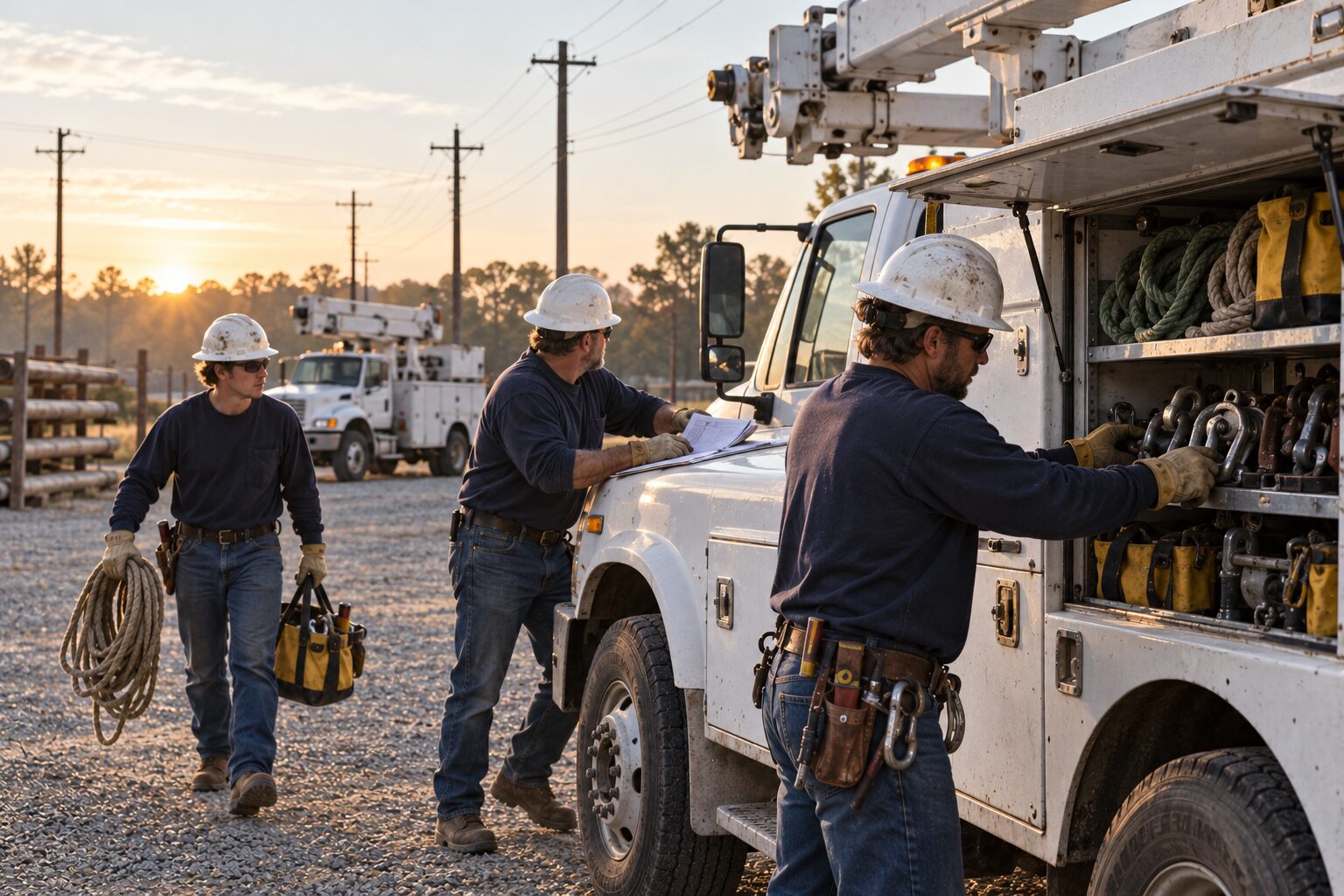
Ask three linemen what they did today and you may get three completely different answers.
One crew may spend the shift replacing a damaged pole. Another may install underground cable in a new subdivision. A trouble crew may chase a partial outage that turns out to be a failed connection. A transmission crew may patrol miles of line and never touch a conductor. Then a storm can erase the plan and keep everyone working through the night.
That variety is the honest answer behind the job title. Linework includes the moments people notice, such as climbing, operating a bucket, and restoring power. It also includes driving, loading material, checking equipment, waiting for clearances, setting up a safe work area, documenting the job, and cleaning up afterward. A crew can have a productive day without anyone spending hours in the air.
If you are considering the trade, here is what the workday usually looks like and why there is no single "normal" shift.
The short answer
Linemen build, maintain, inspect, and repair the overhead and underground systems that carry electricity. The U.S. Bureau of Labor Statistics lists duties such as installing poles and towers, stringing cable, testing equipment, identifying defective devices, and working from poles or truck-mounted buckets.
On a real crew, those duties are mixed with preparation and coordination. A typical planned day often follows this pattern:
- Receive the assignment and review the work order.
- Inspect the trucks, tools, protective equipment, and material needed for the job.
- Travel to the site and evaluate conditions that may not match the drawing or work order.
- Hold a job briefing, assign roles, and set up traffic control and the work zone.
- Complete the construction, maintenance, or repair.
- Inspect the finished work, restore the site, document what changed, and restock for the next job.
Any part of that plan can change when a trouble call comes in, weather moves through, equipment fails, a customer reports a hazard, or the crew discovers something unexpected in the field.
One important qualifier runs through this entire article: the division of work varies. The employer, union agreement, crew makeup, local rules, and worker qualifications can determine who performs switching, cable splicing, excavation, traffic control, vegetation work, or other specialized tasks. A duty that belongs to a line crew at one utility may belong to another classification or contractor somewhere else.
The day starts before the bucket goes up
The workday often starts in the yard, not in the air. The crew needs to make sure it can complete the assignment without making an avoidable trip back for a fitting, tool, or piece of protective equipment.
The foreman or crew leader may review switching instructions, construction prints, maps, customer notes, permits, and the expected condition of the circuit. Crew members check the truck and gather the material. Depending on the job, that could include crossarms, insulators, cutouts, arresters, connectors, wire, grounds, rope, rigging, traffic-control equipment, and replacement hardware.
This is not busywork. A missing connector can stop a carefully scheduled outage. A damaged tool needs to be found before someone depends on it. A poorly organized truck or missing piece of equipment creates problems before the crew reaches the site.
Apprentices often do much of the loading and organizing, especially early in training. The point is not simply to make the newest person carry things. Learning the names, uses, sizes, and storage locations of material is part of becoming useful on a crew. A good apprentice starts recognizing what the job will require before being told every item.
The job briefing is part of the work
Once the crew arrives, the written plan meets the actual jobsite. There may be traffic, soft ground, an unmarked service, a damaged pole, a fence that blocks truck access, a customer generator, or another crew already working nearby.
Before work begins, the crew discusses how the job will be done. OSHA's electric-power rules require a briefing that covers the hazards, procedures, special precautions, energy-source controls, and personal protective equipment associated with the job. OSHA also calls for another briefing when significant changes occur during the work. You can read the requirement in 29 CFR 1910.269 and its practical job briefing guidance.
Crews may call this a job briefing, tailboard, tailgate, or pre-job. The name matters less than the conversation. The crew needs a shared understanding of the task, who is doing what, what is energized, what is grounded or isolated, how equipment will move, and what would make everyone stop and reassess.
An experienced crew can make the conversation look casual because the members know one another. It still has to be specific. "We have done this before" is not a substitute for talking through today's location and today's hazards.
What linemen do on planned construction days
Construction work is the easiest part of linework to picture. It can include setting poles, framing poles, installing crossarms and insulators, stringing conductor, building transformer banks, installing switches, making connections, and constructing underground systems.
The person in the bucket is only one part of that operation. Someone on the ground may operate a digger derrick, handle tag lines, stage material, watch clearances, manage traffic, send tools up, prepare hardware, or communicate with another crew. The work depends on coordinated movement. A lineman aloft cannot safely or efficiently do the job alone.
A pole replacement shows how much work surrounds the part people see. Before any transfer happens, the crew has to get the right pole and hardware to the site, establish access, position equipment, and account for nearby facilities. After the new pole is set, the crew still has to complete the assigned transfers, inspect the finished work, deal with the old pole under local procedures, remove the work-zone setup, and record what changed. Depending on the location, other utilities or communications companies may have their own work to complete.
New construction also involves plenty of measuring and checking. Pole location, framing orientation, conductor sag, clearances, equipment ratings, phasing, and the construction standard all matter. Crews may stop while another department confirms a location, while a switching step is completed, or while an inspector or system operator gives permission to proceed.
On underground work, the day looks different. A crew may pull cable through conduit, install equipment in vaults or cabinets, identify circuits, test equipment, and work around excavations. Splicing and terminating cable may be lineworker duties or may belong to a separate cable-splicer classification. "Lineman" does not automatically mean spending the day on a wooden pole.
Whether a particular task is done energized or de-energized is also job-specific. It depends on the system, the employer's procedures, the available protective methods, the worker's qualifications, and the approved plan for that job. Working energized lines is not a daily requirement for every person carrying a lineman title.
Maintenance can be routine until it is not
Much of the grid already exists, so maintaining it is a large part of the job.
A crew may replace a worn crossarm, damaged insulator, leaking transformer, deteriorated pole, corroded connection, or failed switch. It may transfer facilities from an old pole to a new one, inspect equipment after a vehicle strike, or check a circuit with a history of momentary outages. Vegetation near the line may require coordination with a qualified line-clearance tree crew rather than removal by the line crew itself.
Inspection work can include walking or driving a line, looking for damage, recording pole and equipment conditions, checking rights-of-way, and identifying work for a future crew. The Bonneville Power Administration's description of high-voltage linework includes patrol, repair, equipment operation, and work on wood and steel structures. That is a useful reminder that transmission maintenance can involve miles of travel and assessment before any repair begins.
Routine does not mean unimportant. Catching a cracked component or a damaged structure during inspection may prevent the next outage. It also does not mean risk-free. Familiar work can encourage shortcuts, which is one reason the crew still briefs the job and checks conditions each time.
Trouble calls turn the crew into investigators
Troubleshooting is a different kind of linework. The symptom is known, but the cause may not be.
A report such as "half the house is out," "the lights keep blinking," or "there was a loud pop" gives the crew a place to start, not a diagnosis. Linemen may patrol the circuit, inspect protective devices, check transformers and connections, trace damaged equipment, talk with customers or dispatchers, and narrow the problem until they can isolate and repair it.
A single outage can be a damaged service, a failed connection, an open protective device, a transformer problem, or an issue on the customer's side of the service point. A larger outage may require checking several possible causes across a wide area. The repair itself might be quick after the crew spends an hour finding the failure.
This is where judgment matters. Good troubleshooting is not random activity. It is using the outage pattern, system knowledge, visible evidence, test results, and information from dispatch to choose the next safe check.
Some utilities assign dedicated trouble crews. At other employers, a construction or maintenance crew is pulled from planned work when an urgent call arrives. If you want to know what a particular opening is really like, ask how often the crew handles service calls and outages.
A realistic planned shift, start to finish
Times vary by employer, season, contract, and assignment, but this example shows why an eight-hour shift is not eight hours in a bucket.
Start of shift: assignment and preparation
The crew meets at the yard, reviews the day's work, checks vehicles and equipment, loads material, and confirms that required paperwork or switching instructions are ready. If yesterday's truck was not restocked, the delay shows up now.
At the site: setup and briefing
The drive may take ten minutes or more than an hour. At the site, the crew assesses access and hazards, positions trucks, establishes traffic control, holds the job briefing, and prepares tools and protective equipment.
The main part of the shift
This may be the part outsiders recognize as linework: replacing equipment, transferring wire, setting a pole, pulling cable, making connections, operating equipment, or inspecting a line. Crew members rotate tasks according to classification, training, and the plan. Lunch may happen at the jobsite when schedule and conditions allow.
Before leaving: finish, verify, and restore
The crew completes the work, verifies it, accounts for tools and any protective grounds used on the job, removes traffic control, cleans the site, and updates dispatch or the system operator. Back at the yard, the crew unloads debris, restocks the truck, records material or job status, and prepares for the next assignment.
The interruption that changes everything
At any point, a broken pole, downed wire, fire, vehicle accident, or outage can redirect the crew. The planned job may be made safe and paused while the crew responds. A day that was supposed to end on time can become a long shift with little warning.
Distribution, transmission, underground, and trouble crews have different days
The word "lineman" covers several work environments. Job postings often sound similar even when daily life is not.
Distribution crews
Distribution crews work on the systems that deliver power through neighborhoods, towns, and commercial areas. The work often involves wooden poles, bucket trucks, transformers, services, switches, overhead conductor, and underground distribution equipment. These crews regularly work around customers, traffic, trees, fences, and crowded rights-of-way.
Transmission crews
Transmission work involves higher-voltage lines that move large amounts of power over longer distances. Crews may work on tall wood, steel, or lattice structures in remote terrain. The day can involve specialized rigging, heavy equipment, long patrols, access-road travel, and larger coordinated outages. BPA notes that its crews may use trucks, heavy equipment, and helicopters depending on the work.
Underground and cable crews
Underground crews work with conduit, vaults, manholes, cabinets, terminations, and cable. The physical environment can be tight, muddy, hot, wet, or difficult to access. Precise identification and testing matter because much of the system is not visible from the surface. Some employers combine overhead and underground duties. Others use dedicated underground or cable-splicing crews.
Service and trouble crews
These crews respond to outages, damaged equipment, voltage complaints, hazards, and service problems. Their schedule may be less predictable, and customer communication is often a larger part of the job. They need broad system knowledge because the next call may have little in common with the last one.
The distinction between utility and contractor work also changes the rhythm of the day. A utility crew may stay in one service territory and handle more customer or trouble work. A line contractor may move between projects, jurisdictions, and employers. The utility and contractor comparison explains those differences in more detail.
What apprentices, journeymen, and foremen do differently
Everyone belongs to the same crew, but they do not carry the same responsibility.
An early-step apprentice commonly loads material, organizes tools, sets up the work area, assists from the ground, operates equipment when qualified and directed, and performs tasks that match the current stage of training. As the apprentice progresses, the work becomes more complex and independent, but it remains supervised.
A journey-level lineworker is expected to understand the system, perform skilled work, recognize changing hazards, guide apprentices, and contribute to decisions without needing every step explained. Journey status does not mean the learning is over. Equipment, standards, and local systems differ, and even experienced linemen ask questions when a condition is unfamiliar.
The foreman or crew leader coordinates the whole job. That can include interpreting the work order, communicating with dispatch or system operators, assigning tasks, confirming the crew's plan, managing changes, and taking responsibility for progress and documentation. The role often involves less uninterrupted tool time than people expect. Our guide to what changes when you become a line foreman covers that transition.
Apprenticeship assignments may also rotate so the apprentice gains experience across the system. Seattle City Light's apprenticeship overview, for example, describes working under journey-level employees and rotating through crew assignments. The exact progression depends on the employer or apprenticeship program.
How much of the day is climbing?
For many crews, less than social media makes it seem.
Climbing is still a core skill in many line apprenticeships and jobs. It matters when a bucket cannot reach the work, when the employer requires it, or when the crew works on structures that must be climbed. But many distribution tasks use aerial lifts, and many ground tasks must happen before anyone goes aloft.
There is no honest national percentage for time spent climbing. It depends on the crew, territory, equipment, and project. A pole-change crew in a tight alley may climb more than a crew rebuilding an accessible roadside circuit with two bucket trucks. A transmission crew may climb tall structures on one assignment and operate equipment or patrol line on another.
Do not judge the career only by whether climbing looks exciting. Ask whether you can stay focused through the preparation, ground support, equipment operation, travel, cleanup, and repetitive tasks that make the visible work possible. Bucket time and climbing time are poor measures of whether the crew accomplished important work.
The job is physical, but attention is just as important
Linemen lift, carry, pull, climb, kneel, work with hand tools, and spend long periods on their feet. They also work in heat, cold, wind, rain, traffic, mud, vegetation, and confined spaces depending on the assignment.
The mental demand is just as real. Workers must remember the plan, track equipment and people, communicate clearly, watch for changing conditions, and stop when something no longer matches the briefing. O*NET's current work-context profile for electrical power-line installers and repairers reflects how consistently workers report outdoor exposure, protective equipment, hazardous conditions, team discussion, and irregular schedules. It also identifies troubleshooting, coordination, judgment, equipment operation, inspection, and repair as important parts of the occupation.
Fatigue changes all of that. A long restoration shift is not merely a normal day with more hours added. Travel, poor weather, interrupted sleep, and repeated high-consequence decisions accumulate. That is why a realistic view of linework risk has to include work practices and fatigue, not just fear of electricity or heights.
Storm work is not the everyday schedule
Storm restoration is part of the trade, but it is not a good picture of every day.
During a major event, crews may work extended shifts, sleep away from home, eat when the schedule allows, wait at staging areas, and receive assignments through a larger restoration organization. The work can include patrolling circuits, clearing access, replacing broken poles, repairing wire, and restoring sections of the system in a planned order.
There can be long stretches of waiting followed by intense work. A crew may wait for an assignment, material, access, another crew, or permission to proceed. That waiting is not necessarily poor planning. Large restoration efforts have dependencies, and moving too early can put crews in conflict with one another.
The overtime can be substantial, but it comes with real tradeoffs. If you are evaluating this career, do not build your household budget around storm hours or assume every employer handles travel, lodging, meals, and rest the same way.
The work includes paperwork and people
Lineworkers are not office workers, but records still matter. Depending on the employer and role, the crew may document installed material, equipment numbers, inspections, test results, switching steps, time, vehicle condition, damage, customer contact, and the final status of the job.
There is also more interaction with the public than many applicants expect. A lineman may explain why access is needed, tell a customer what the crew can and cannot repair, coordinate with police or fire personnel, work around other trades, or answer questions from someone frustrated about an outage.
You do not need a polished sales voice. You do need to stay clear and professional when someone is tired, worried, or standing near a dangerous situation.
Questions to ask before accepting a lineman job
The title alone will not tell you what your days will look like. Ask the employer or apprenticeship program:
- Is this primarily distribution, transmission, underground, service, or a mix?
- Does the crew focus on new construction, maintenance, trouble work, or all three?
- Which duties are handled by separate classifications or subcontractors?
- How large is a normal crew, and who leads it?
- What is the normal reporting location, and how much paid or unpaid travel is typical?
- How often are employees on call?
- How are callouts assigned, and what is the expected response time?
- How much storm travel happened during the last year?
- Do crews normally work energized lines, de-energized lines, or both under the employer's procedures?
- What equipment does the crew use most often?
- How are apprentices rotated and evaluated?
- What does a normal week look like when there is no storm?
Listen for specifics. "We do a little of everything" is less useful than hearing that a crew spends most weeks on overhead distribution construction, rotates on call every six weeks, and helps with local outages as needed. The second answer gives you something you can compare with the life you want outside work.
The honest bottom line
A lineman's day is not eight straight hours in hooks or a bucket. It is a sequence of preparation, communication, physical work, equipment operation, problem-solving, travel, documentation, and cleanup. Some days are steady and planned. Others change with one radio call.
The trade suits people who can handle both sides of that reality. You need to be willing to do demanding work at height or around heavy equipment, but you also need the patience to check material, listen through a job briefing, wait for the system to be ready, and do ordinary ground work correctly.
If that full picture still appeals to you, not just the most dramatic five minutes, you may be looking at the right career. Compare the actual employers and apprenticeship programs in your area. The crew you join, the system it maintains, and the callout expectations will shape your day far more than the job title alone.