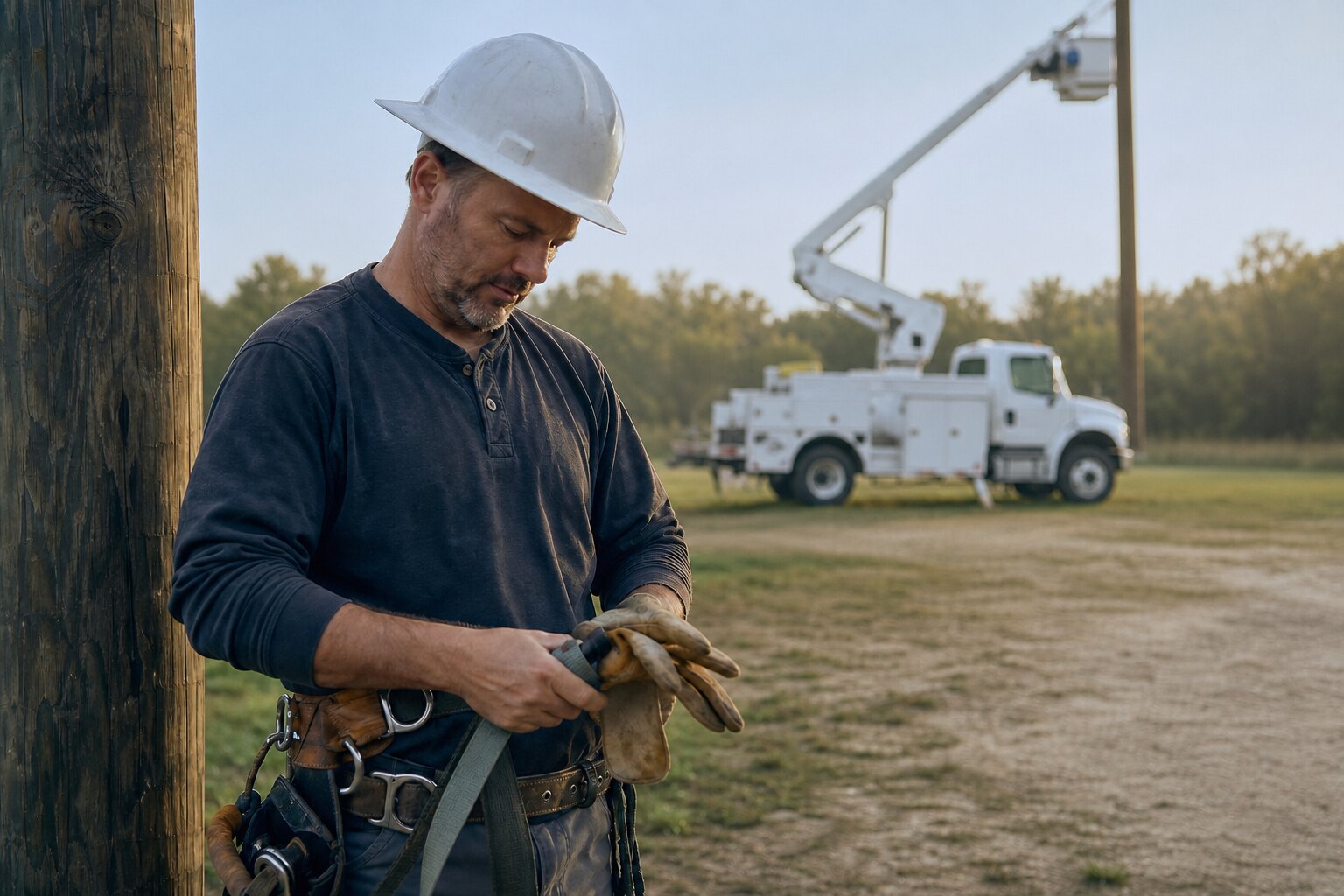
Thirty-five is not too old to become a lineman. Forty-two is not automatically too old either.
But "not too old" is not the same as "this is the right move."
Age is usually not the first thing that stops a serious career changer. Apprentice wages, travel, an unforgiving schedule, the physical wear of doing hard work day after day, or the need to start at the bottom can matter much more.
If you are asking this question, you probably do not need another stranger to say, "Go for it." You need a way to judge the decision honestly. This guide will help you do that.
The short answer
There is no standard trade-wide upper age cutoff for becoming a lineman. Many apprenticeship programs publish a minimum age, often 18, along with requirements for a driver's license, commercial driver's license, education, testing, and physical ability. Your exact program or employer can set additional job-related qualifications, so always read its current rules.
Federal law also matters. The U.S. Equal Employment Opportunity Commission explains that the Age Discrimination in Employment Act generally protects applicants and workers who are 40 or older. It generally prohibits age discrimination in apprenticeship programs too, subject to limited exceptions.
That does not mean every applicant at every age can perform the job. Linework is physically demanding, safety-sensitive work. It often involves heights, bad weather, irregular hours, emergencies, and time away from home. The Bureau of Labor Statistics notes that line installers and repairers may work long hours after storms and other emergencies, and that apprentices may have to meet physical requirements or pass fitness tests.
So the useful question is not simply, "Am I too old?"
It is, "Can my body, finances, household, and attitude handle several years of becoming a safe and dependable lineworker?"
Age matters less than your starting point
Two 40-year-old applicants can be in completely different positions.
One may already work outside, hold a Class A CDL, lift and carry material every day, and have a household budget that can absorb an apprentice wage. The other may have spent 15 years at a desk, need to replace a current salary immediately, and be unable to travel overnight.
Their birth year is the same. Their readiness is not.
An older applicant can bring useful strengths to a crew: showing up on time, listening, staying calm under pressure, taking care of equipment, and understanding that safety rules are not optional. Experience in construction, trucking, heavy equipment, the military, telecommunications, tree work, or industrial maintenance may also make parts of the transition more familiar.
None of that lets you skip being new. You will still need to learn the trade, follow the apprenticeship process, and take direction from people who may be younger than you.
That last part deserves an honest look. If you cannot accept correction from a 26-year-old journeyman who knows the work, age is not your problem. Pride is.
The physical test is repeatability, not one hard workout
People often reduce the physical question to, "Can I climb a pole?" That is too narrow.
The work can require climbing, lifting, pulling, carrying, digging, handling tools, working with your arms raised, getting in and out of equipment, and staying focused while tired. It can happen in heat, cold, wind, rain, mud, and darkness. O*NET's occupation profile for electrical power-line installers and repairers reports that outdoor work, hazardous conditions, high places, and workweeks longer than 40 hours are common parts of the occupation.
The real test is whether you can do demanding work safely on Tuesday morning after a hard Monday, then return and do it again on Wednesday. A single gym session does not answer that.
Before applying, compare yourself with the published essential functions and physical test for the specific employer or program. If you have an old injury, a medical condition, or a concern about working at height, get appropriate professional advice instead of guessing. Do not try to imitate climbing or linework without qualified instruction and the correct equipment.
You can still build a useful baseline safely. Regular walking on uneven ground, general strength training, carrying manageable loads, mobility work, sleep, and recovery can reveal whether your current routine supports physical work. The goal is not to look like a fitness model. It is to move well, recover well, and keep making safe decisions when you are uncomfortable.
Apprentice pay may be the hardest part of starting later
Many career changers can handle the work. Their budget cannot handle the reset.
A registered apprenticeship normally combines paid work, instruction, and progressive wage increases. The federal Registered Apprenticeship requirements guide describes a wage schedule that increases as an apprentice develops skills. Outside-line programs often set apprentice rates as a percentage of the journey-level rate.
For example, Northwest Line JATC publishes wage steps that begin at a percentage of the journeyman rate and increase with hours and training progress. Those raises matter over time. They do not change what lands in your account at the first step.
If you have a mortgage, children, debt, or health insurance tied to your current job, do not compare today's income with a future journeyman wage. Compare it with the apprentice wage you could actually receive in the first year.
Build a written change-of-career budget that includes:
- expected take-home pay at the starting apprentice rate;
- union dues, training deductions, and tool or equipment costs;
- health insurance premiums and any waiting period;
- commuting fuel, parking, and vehicle wear;
- CDL, testing, document, or certification costs;
- lodging and meals if the work travels;
- child care or household help created by a changing schedule; and
- enough breathing room for reduced hours, a delayed start, or a job assignment ending.
Do the math without counting overtime that has not been promised. Overtime can be common in some parts of linework, but it is not a safe foundation for a household budget.
The lineman salary guide can help you understand the long-term earnings picture. It should not be used to pretend you will start at the median wage for the whole occupation.
If you are starting in your 50s, do the time-horizon math
Starting at 50 or 55 is not automatically too late. It does make the calendar more important.
Northwest Line JATC describes its 7,000-hour apprenticeship as approximately three and a half years. The Missouri Valley Line Constructors Apprenticeship Program says its 7,000-hour program takes nearly four years. Your program may be shorter or longer depending on its standards, your work hours, and your progress.
If you start at 52, you may be 55 or 56 before reaching journey level. That can still leave time for a worthwhile second career, but you should look beyond the first-year wage and ask:
- How many working years do I realistically want after completing the apprenticeship?
- When do health, retirement, or pension benefits begin and vest?
- Would I still choose the work if advancement takes longer than expected?
- Does the likely journey-level income justify the apprentice pay cut and training costs for my household?
There is no universal age at which this calculation stops working. The answer depends on the actual program, benefit plan, wage progression, and the number of years you expect to remain in the trade.
Travel can be a bigger obstacle than age
You may be physically ready and financially prepared, but unable to go where the work is.
Some utility apprenticeships are tied to a utility's service territory. Outside construction apprenticeships can cover a much larger jurisdiction and assign apprentices according to contractor demand and training needs. Missouri Valley tells applicants that the work requires a fair amount of travel and many nights away from home. Northwest Line JATC says its apprentices must be willing to work throughout its multistate jurisdiction and are responsible for their own travel expenses.
Do not assume you will find a nearby opening, keep the same show-up for years, or receive per diem on every assignment. Ask the apprenticeship office directly:
- How large is the jurisdiction?
- Who chooses an apprentice's assignment?
- How much notice is typical before a new assignment?
- Can the show-up move during the apprenticeship?
- Are lodging, per diem, mileage, or travel time provided?
- What happens if an apprentice cannot report to a distant assignment?
Then have the same conversation with the people who depend on you. "I may travel" is vague. "I may be assigned three hours away and need to stay there during the week" is a decision your household can actually discuss.
Our guide to utility and line-contractor jobs explains how the employer type can change territory, storm response, schedule, and job stability. Those differences matter when you are choosing a career, not just an opening.
Starting older means becoming a beginner again
This part surprises people who have already built a career.
You may be a supervisor, business owner, veteran, experienced operator, or the person everyone calls when a problem appears. In an apprenticeship, you are still the apprentice. Your prior experience can make you more useful, but it does not make you qualified to perform linework you have not learned.
A strong older apprentice can say:
- "I do not know. Show me."
- "I misunderstood the instruction. I will correct it."
- "I am not comfortable proceeding until I understand the hazard."
- "I can help with that, but I have not been trained to do this part."
That is not weakness. In a safety-sensitive trade, pretending to know is dangerous.
Be ready for early mornings, basic tasks, classroom work, tests, evaluations, and correction in front of other people. Be ready for a younger coworker to know far more than you about rigging, grounding, cover-up, equipment setup, or the local work rules. You do not have to act young. You do have to remain teachable.
Previous experience helps, but only in specific ways
Career changers sometimes ask whether past work will shorten the apprenticeship. Do not assume it will. A registered program has its own standards, required hours, related instruction, and rules for granting credit.
Past experience is most useful when it changes how you show up today.
A CDL and a clean driving record may help you meet application requirements. Construction experience may mean you already understand jobsite communication, weather, early starts, and production pressure. Heavy-equipment experience may help with inspections and situational awareness. Military experience may help with procedures, teamwork, and taking responsibility. Electrical or telecommunications experience may make certain concepts more familiar.
The value is real, but limited. Running an excavator does not make you a lineman. Residential electrical work does not make you qualified for overhead distribution. Good programs and employers care about relevant experience, but they also care whether you respect the limits of that experience.
If you are deciding between entry points, read the comparison of groundman and apprentice lineman roles. A groundman position can expose you to outside line construction and let an employer see how you work, but it is not automatically the same as entering a formal apprenticeship.
A practical career-change self-audit
Answer these questions in writing. A vague "probably" is not enough.
1. Do I meet the actual entry requirements?
Pull the application page for the exact apprenticeship or employer. Check minimum age, education, algebra, driver's license, CDL class and restrictions, medical card, testing, residency, certifications, and document deadlines.
Do not use a social media comment from another jurisdiction as your rule. The lineman apprenticeship guide explains the common paths and the questions to verify before paying for training.
2. Can I pass the physical requirements and recover for the next day?
Find the published test or essential functions. Identify your current gaps. Make a sensible plan to improve them, and get professional guidance where health or injury is involved.
3. Can my household live on the starting wage?
Use the lowest verified first-step rate, a normal workweek, and realistic deductions. Add the costs created by the job. Do not use a journeyman rate or a storm week to make the budget balance.
4. Can I accept the travel and schedule?
Ask about the whole jurisdiction, not only the address on today's posting. Decide what overnight travel, storm response, shift changes, and long commutes would mean for your family before an assignment forces the decision.
5. Can I be coached like a first-year apprentice?
Imagine taking a direct correction from someone 15 years younger while you are tired and other crew members can hear. If your first instinct is to defend your resume, work on that before you join a crew.
6. Am I choosing the work or chasing the image?
The trade includes skilled, meaningful work and the chance to build a strong career. It also includes digging, material handling, inspections, maintenance, paperwork, waiting, travel, weather, and repetitive tasks. Make sure you want the real job, not only the photographs of helicopters and storm crews.
Run a 30-day reality check before you resign
You do not need to quit your current job to begin testing the decision.
Over the next 30 days:
- Choose three real apprenticeship programs or employers in places where you can actually work.
- Write down every published requirement and the next application window.
- Contact the program or hiring office with specific questions that the website does not answer.
- Price the CDL, documents, travel, tools, and other costs you would pay before the first check.
- Build the first-year household budget using a verified starting rate.
- Compare your current physical baseline with the program's published demands, without attempting unsafe linework on your own.
- Talk through travel, child care, insurance, and schedule changes with your household.
- Apply for appropriate openings before spending heavily on a line school that your target program may not require.
You can also review current apprentice lineman jobs to see what employers are requiring now. Treat each posting as one employer's requirements, not a universal rule.
At the end of the month, you should have facts: the qualifications you meet, the gaps you can close, the wage you may start at, the territory you may cover, and the effect on the people at home.
That is a much better foundation than deciding based on age alone.
When the answer may be no
Sometimes the honest answer is that becoming a lineman is not the right career change now.
It may be a poor fit if the essential physical demands cannot be performed safely, the starting wage would put your household in immediate trouble, the required travel is impossible, or you do not want to spend several years as an apprentice. Those are not character flaws. They are real constraints.
You might also decide to wait while you earn a CDL, improve your conditioning, reduce debt, arrange family support, or target a utility with a smaller service territory. "Not this year" is different from "never."
If linework itself does not fit, look at other utility and electrical-infrastructure roles that use parts of your background. The right alternative depends on your qualifications and local employers, but it is better to choose work that fits your life than to force yourself into a job because the title sounds good.
The bottom line
You are not automatically too old to become a lineman at 30, 35, 40, or beyond. There is no single birthday that answers the question for every applicant.
What matters is whether you can meet a real program's requirements, perform the work safely, recover from it, live on the early apprentice package, go where the work requires, and stay teachable while you build skill.
Do not let age talk you out of a career you are prepared to pursue. Do not let encouragement talk you into ignoring your body, budget, or family either.
Get the requirements. Run the numbers. Ask the uncomfortable questions. Then make the decision from evidence, not fear.