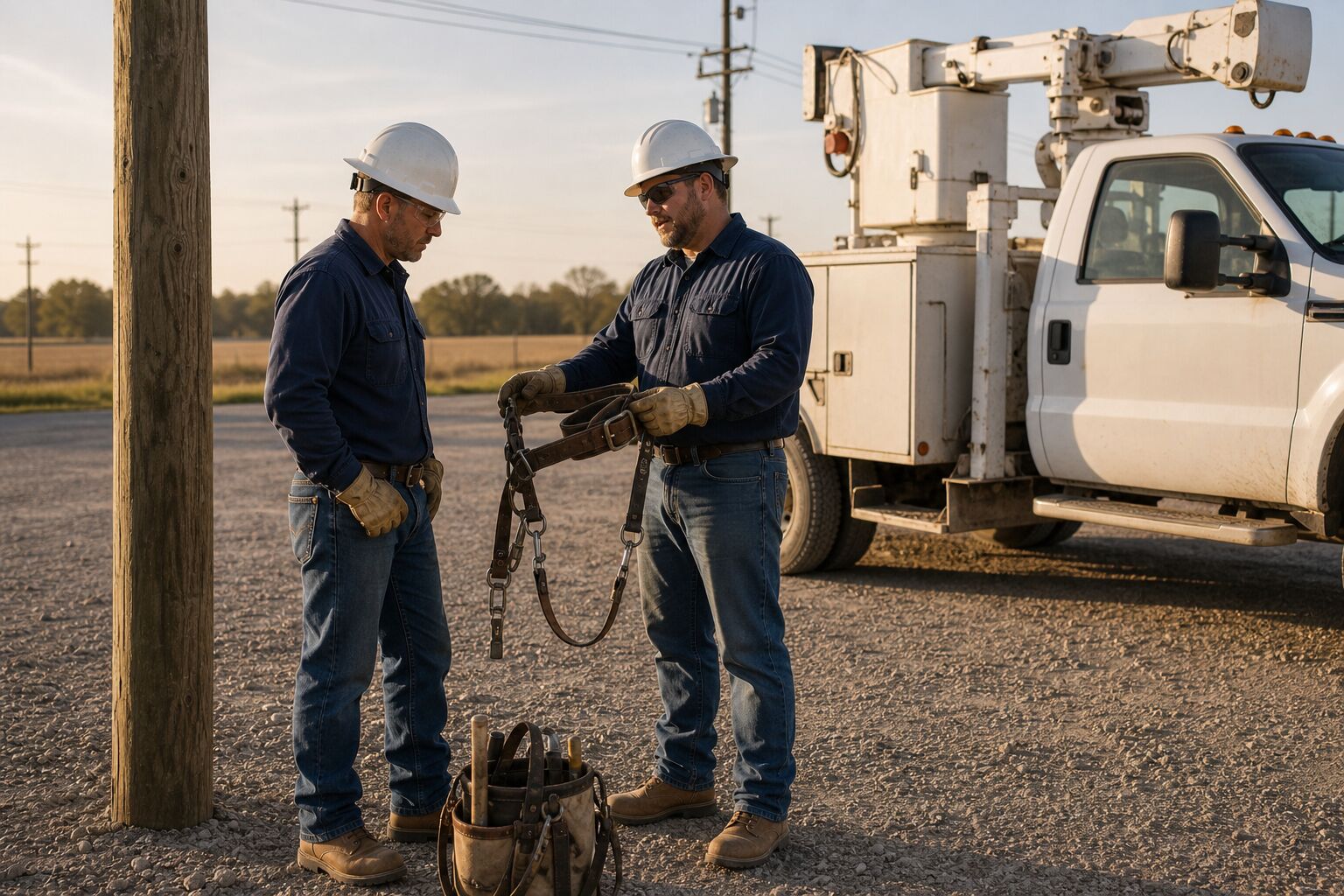
You can be a good electrician and still be brand new to linework.
That is the part of this career change people tend to get wrong. Some electricians assume their license should put them halfway through a line apprenticeship. Others assume none of their experience will matter and that the last several years were wasted. Neither view is especially useful.
Your electrical background can make you a stronger applicant and a faster learner. It may even earn you formal credit in some apprenticeship programs. But it does not automatically qualify you to climb, work from an aerial device, apply line cover, operate utility equipment, or perform energized line tasks.
The real answer depends on what kind of electrical work you have done, where you want to work, and who controls training and classification there. Here is how to separate the experience that helps from the credentials that do not simply carry over.
The short answer
Most electricians who move into power linework should expect to enter a line apprenticeship and prove themselves in the new trade. Some programs may grant advanced standing for documented, relevant experience, but there is no national rule saying that an electrician license converts into a particular line apprenticeship step.
The U.S. Department of Labor says a registered apprenticeship sponsor may award credit for previous work or classroom experience when the sponsor approves it. That decision is made case by case.
There is an important wrinkle in the Department's current public guidance. Its general prior-experience FAQ still says an apprentice must participate for at least six months or 1,000 hours to receive a completion credential. A newer March 2026 Office of Apprenticeship circular expressly rescinds that earlier minimum because the regulation does not impose it. The newer circular leaves completion tied to the requirements in the sponsor's approved standards.
Because those federal pages do not currently say the same thing, do not treat 1,000 hours as a universal federal floor or assume that your program allows a shorter path. Ask the sponsor what its approved standards require and, if the answer is unclear, ask which Registration Agency oversees the program.
So yes, your experience can count. No, you should not build a career plan around receiving credit until the program gives you a written answer.
“Starting over” can mean four different things
When someone says you will have to start over, ask what they mean. Four separate decisions often get bundled into that phrase:
- Application: Do you enter the normal applicant pool, or is there a route for experienced workers?
- Classification: Are you hired or dispatched as a groundman, line apprentice, or another classification?
- Training credit: Will any previous classroom or on-the-job experience reduce what you must complete?
- Pay: If you receive advanced standing, does your wage move to the corresponding apprentice step?
Getting credit in one area does not answer all four questions. An interview committee may value your electrical background but still start you as a first-step apprentice. A program may credit a class without crediting field hours. A utility may hire you above its minimum rate but still require its entire lineworker training progression.
Who makes those decisions depends on the path. In an outside-line apprenticeship, the JATC or other sponsor applies its registered standards, and dispatch or referral rules may involve the outside local. At a utility, the job posting, collective bargaining agreement when one applies, and the company's training and qualification rules may control the answer. Ask the organization that owns each decision instead of relying on what a coworker heard about another program.
These trades share electricity, not a qualification card
Electricians and electrical lineworkers both work around electrical systems, use technical drawings, troubleshoot problems, and depend on disciplined safety practices. That is meaningful overlap.
The work itself is different.
The Bureau of Labor Statistics describes electricians as workers who install, maintain, and repair power, communications, lighting, and control systems in homes, businesses, and factories. Their training commonly covers electrical theory, blueprint reading, mathematics, the National Electrical Code, and building wiring methods.
The same agency describes electrical power-line installers and repairers as workers who install and repair the cables and wires used in electrical power transmission and distribution. The job can involve poles, towers, aerial devices, underground systems, heavy equipment, bad weather, remote rights of way, and long emergency shifts.
The distinction also exists inside organized electrical training. The Electrical Training Alliance lists inside wireman and outside lineman as separate specialties with separate apprenticeship tracks. Sharing an electrical foundation does not make the classifications interchangeable.
Knowing why a transformer works is not the same as knowing how your employer requires a crew to frame a pole, control a conductor, establish an equipotential zone, or work a particular distribution system. Even familiar words may refer to different procedures in a different setting.
Think of your electrician experience as a strong foundation, not a transfer certificate.
What usually transfers well
The best parts of your background are often habits and ways of thinking rather than a list of tasks you can immediately perform without supervision.
Electrical theory and technical comprehension
If you understand voltage, current, grounding, transformers, phase relationships, fault paths, and basic power calculations, the classroom side of apprenticeship may feel less foreign. You may also be comfortable reading one-line diagrams, schematics, prints, specifications, and equipment information.
That head start is useful. It can help you understand the reason behind a linework procedure instead of memorizing a sequence without context.
It can also create false confidence. Distribution and transmission systems have hazards, system conditions, work methods, and operating rules that you may not have encountered in premises wiring. Use your theory to ask sharper questions, not to assume you already know the field procedure.
Respect for electrical hazards
An electrician who has developed careful habits around testing, personal protective equipment, energy control, and unexpected sources already understands that electricity punishes assumptions.
That mindset transfers. The exact methods do not.
Linework has its own requirements for qualifications, minimum approach distances, grounding, cover-up, switching, clearances, job briefings, and work from aerial devices. The applicable federal rules also depend on the work. OSHA 1910.269 generally covers operation and maintenance of electric power generation, transmission, and distribution installations, while OSHA Subpart V addresses construction of electric power transmission and distribution systems.
Your employer's procedures and qualified instruction have to govern the job. A lockout process you used in a plant does not automatically replace a utility clearance or line grounding procedure.
Tool sense and mechanical ability
Electricians often arrive knowing how to use hand tools, power tools, test equipment, ladders, lifts, and material safely. They may understand torque, fasteners, pulling tension, cable handling, conduit, terminations, equipment inspection, and how to protect finished work.
Industrial and commercial electricians may bring relevant experience with switchgear, motors, control systems, medium-voltage equipment, cranes, rigging, or large cable. An electrician who has actually performed that work should document it specifically.
Do not stretch the connection. Using a scissor lift does not qualify you to run a bucket truck. Pulling feeder cable through a building does not establish that you can control a conductor in the air. Familiarity helps you learn, but line equipment still requires line-specific training and demonstrated proficiency.
Construction habits and crew awareness
If you have worked on active construction sites, you may already be comfortable with early starts, changing plans, material staging, weather, heavy equipment, production pressure, and coordinating with other trades. You may know how to keep a work area clean, protect tools, communicate clearly, and recognize when the plan no longer matches the field.
Those are valuable crew habits. A first-step apprentice who shows up ready, listens, anticipates the next ordinary need, and does not have to be reminded to care for equipment is easier to teach.
Troubleshooting without guessing
Experienced electricians learn to gather information, test carefully, and narrow a problem instead of replacing parts at random. That discipline carries well into utility work.
The limit is authority. On a power system, troubleshooting may involve switching orders, system operators, protective devices, multiple sources, induced voltage, backfeed, or conditions far beyond what is visible at the work location. Good judgment includes knowing when the next decision belongs to someone else.
What does not transfer automatically
This is where career changers can get frustrated. The program is not necessarily dismissing your experience when it starts you at the beginning. It may be recognizing that the missing pieces are the ones most likely to hurt you or another crew member.
Your electrician license
A state or local electrician license proves that you met the requirements for that license. It does not by itself make you a journey-level lineworker, and it usually does not replace a line apprenticeship completion credential or an employer's qualification process.
Keep the license current if it is practical. It is a valuable credential and may matter for future roles. Just do not present it as proof that you can perform line tasks you have not been trained and evaluated to perform.
Your journey-level status
Being a journeyman electrician means you are experienced in your trade. When you enter another trade, you can be an experienced worker and a beginning line apprentice at the same time.
That is not an insult. A commercial electrician would not turn a journey-level lineworker loose to wire a hospital simply because both jobs involve electricity. The same logic works in the other direction.
If you are an IBEW inside wireman, call both the apprenticeship office and the outside local you would work through. Ask the apprenticeship office about training credit. Ask the local about classification, referral, and book-signing rules. Do not assume that union membership in one branch of the trade places you in the journey-level lineworker classification in another.
Line-specific work methods
The largest gap is usually not electrical theory. It is the body of practical linework you have not yet performed under qualified supervision.
That can include:
- climbing and work positioning;
- pole-top and aerial rescue;
- setting and framing poles;
- conductor handling, sagging, and tensioning;
- distribution and transmission rigging;
- cover-up and rubber protective equipment;
- live-line tools and energized work methods;
- testing, grounding, bonding, and equipotential work zones;
- operating digger derricks, aerial devices, winches, and line trucks;
- underground distribution equipment and cable systems;
- traffic control, roadside setup, and public protection; and
- storm restoration on damaged or unfamiliar systems.
That list is not a do-it-yourself curriculum. It is a reminder of why an apprenticeship evaluates actual line experience rather than the job title on your old pay stub.
OSHA requires employers to determine that workers have the training and proficiency needed for their assignments. Under 1910.269, a worker with previous training may be examined or interviewed initially, but the employer must closely supervise that worker until demonstrated proficiency is established. Past experience can change the evaluation. It does not remove the employer's responsibility to verify what you can safely do.
A commercial driver's license
An electrician license and a CDL solve different problems. Many line apprenticeships and employers require a Class A CDL, sometimes with specific endorsements or without certain restrictions. For example, Northwest Line JATC currently requires a Class A CDL with no E restriction, along with other application documents and certifications. Other programs set different deadlines and restrictions. If you do not already have the required license, your electrician credentials will not substitute for it.
Read the actual application rules before you pay for training. Our guide to CDL rules, driving records, and line apprenticeships explains what to verify if your license or motor vehicle record could affect eligibility.
Credit for every hour you have worked
Ten thousand hours as an electrician do not become ten thousand line apprenticeship hours. Programs usually care about the work processes you performed, the training attached to them, and how closely they match the occupation being taught.
Hours spent installing service equipment may be more relevant than hours spent trimming receptacles, but even relevant electrical work may not satisfy a linework category. The sponsor decides what its standards allow and what your records prove.
Can electrician experience shorten a line apprenticeship?
Possibly, but treat it as an exception you must document, not a benefit you can assume.
Registered apprenticeship sponsors can evaluate prior work and classroom experience under their approved standards. The answer can differ between two programs, even if both train outside lineworkers. A program may give no credit, classroom credit only, a higher placement after testing, or a limited number of on-the-job hours.
There is no federal 50 percent ceiling on advanced standing. The same March 2026 circular rescinded older guidance that had asserted such a limit. It says sponsors must follow a written policy, apply objective criteria uniformly, and keep documentation supporting each decision. Removing a federal ceiling does not require a local sponsor to grant any particular amount of credit.
The circular also connects advanced standing to wages. It says any progression step granted must come with commensurate wages. Before you count on a particular rate, confirm which step the sponsor is granting and how its current wage schedule applies.
Some programs may reserve alternative entry or advanced placement for documented outside-line experience. Those routes can open, close, or move, so check the sponsor's current program materials instead of relying on an older application page. For example, Missouri Valley Line Constructors now directs applicants to its current lineman program and published policy statement. Inside electrical hours are not automatically outside-line hours, and special entry routes can change.
Ask about prior credit before or during the application process. Do not wait until after accepting a classification and wage step, because the program may require the request and supporting records at a particular stage.
Bring evidence that can actually be evaluated:
- apprenticeship completion documents;
- an electrician license and its current status;
- official classroom transcripts with course names and hours;
- employer letters showing dates, hours, job titles, and detailed duties;
- records of work processes completed during your apprenticeship;
- safety, equipment, first-aid, and CPR training cards;
- CDL documentation; and
- pay records or other reliable proof when an employer letter is unavailable.
“I have been an electrician for eight years” is a claim. “Here are my verified hours by work process and the related courses I completed” is something a training director can review.
If credit is offered, ask for the decision in writing. Confirm which on-the-job hours and classes were credited, your starting step, your wage rate, and your remaining requirements. Also ask what happens to the credit if you leave the employer, move to another local, or enter a different program. A completed Registered Apprenticeship provides an industry-recognized, portable credential. An incomplete apprenticeship record or local placement decision may need a new evaluation.
Will being an electrician help you get selected?
It can. Selection committees and employers may see evidence that you can finish an apprenticeship, work around electrical hazards, read technical information, use tools, and function on a construction crew.
The way you describe the experience matters.
Weak answer: “I am already a journeyman, so I should move up quickly.”
Better answer: “My electrical apprenticeship taught me theory, job planning, testing, and disciplined work habits. I also know linework is a different trade, and I expect to learn its methods from the beginning.”
Be specific on the application. If you worked outdoors through winter, say so. If you drove commercial vehicles, operated equipment, performed documented rigging, worked with medium-voltage gear, led job briefings, or trained apprentices, describe the actual scope. Do not turn adjacent experience into line experience.
Also remember that experience is only one part of eligibility. A program may rank applicants using an aptitude test, interview, CDL status, physical requirements, education, work history, or other published factors. Start with the official rules for the exact program. The lineman apprenticeship guide explains the common paths and what to verify before applying.
The attitude that makes the transition work
The strongest electrician-to-lineman candidate can hold two ideas at once:
- “I bring useful skills and years of proven work habits.”
- “I am new to this trade and need to be taught.”
That balance is harder than it sounds. You may take direction from someone younger than you. You may spend the morning handling material or cleaning a truck after years of running electrical jobs. You may know more electrical theory than another apprentice and still be the least experienced person at framing a pole.
Do not hide what you know, but do not make the crew argue with your resume. Ask how this employer does the work. Repeat instructions when the task is unfamiliar. Say plainly when you have not been trained on a tool, truck, or procedure. Let your background show through preparation and judgment.
In linework, humility is not pretending you know nothing. It is refusing to claim more than you can demonstrate.
Questions to ask every program before applying
Call the apprenticeship office or training director and ask direct questions. You are looking for the policy that applies to you, not a general encouragement to submit an application.
- Does a journey-level electrician license affect application ranking or eligibility?
- Who decides my classification, and is that separate from the apprenticeship credit decision?
- Does the program award prior credit for electrical work, classroom training, or both?
- Must the experience be outside linework, or can commercial, industrial, substation, or medium-voltage work qualify?
- When must I request credit?
- What records are accepted as proof of hours and work processes?
- Is there a written exam, practical evaluation, or probationary period?
- If credit is awarded, what apprenticeship and wage step will I enter?
- Which classes and on-the-job work processes will I still need to complete?
- What happens to awarded credit if I change employers, locals, or programs?
- What CDL class, endorsements, and restrictions are accepted at application and at dispatch?
Write down the name and role of the person who answered. If the decision affects several years of wages or training, ask where the rule appears in the program standards or request written confirmation.
A practical transition plan
You can investigate the move without immediately giving up a good electrical job.
1. Choose the linework path you actually want
Start by deciding whether you are targeting a utility apprenticeship, an outside construction apprenticeship, or a line contractor that trains employees through another structure. Territory, travel, hiring, work assignments, and training can differ. Our utility and line contractor comparison will help you ask the right questions.
Do not apply to “linework” in the abstract. Make a short list of real programs and employers you could accept.
2. Pull the official requirements
For every target, record the application window, CDL requirement, education documents, tests, fees, travel territory, starting wage, and prior credit policy. Requirements change. Use the program's current website and confirm unclear details with the office.
If you are pursuing outside construction, call the JATC and the outside local because training and referral questions may have different answers. If you are pursuing a utility, ask human resources or the hiring manager for the line progression and the agreement that governs starting classification and pay.
3. Build your experience file
Request transcripts and detailed employment letters while former supervisors and payroll records are still available. Break your experience into tasks and hours wherever possible. Gather licenses, cards, certifications, and proof of apprenticeship completion.
This file is useful even when a program grants no formal credit. It helps an interviewer see exactly what you bring.
4. Close the obvious eligibility gaps
If the program requires a Class A CDL, algebra documentation, CPR, a medical certificate, or another prerequisite, make a plan based on its stated deadline. Do not assume line school is required unless the program says it is. Do not pay for a private course until you know how the target program treats it.
5. Price the reset honestly
Compare your current take-home pay with the verified first-step apprentice wage, not the future journeyman rate. Add commuting, travel, lodging, tools, dues, insurance changes, and the possibility of uneven hours.
Then compare the work itself. Linework may bring more travel, storm response, heights, weather exposure, and schedule disruption than your current electrical role. The long-term earning potential matters, but so does the life required to reach it. Use the lineman salary guide for context, not as a first-year paycheck estimate.
6. Apply while you still have choices
An application is not a resignation letter. Learn the timeline, complete the steps, and wait for a real offer or apprenticeship placement before leaving stable work. Ask what happens between selection, orientation, indenture, and the first paid assignment.
If possible, talk with current apprentices from the exact program. Ask where they travel, how consistently they work, what the first year is really like, and which costs surprised them.
When starting over may not be the best move
You do not have to become a lineworker to build a career closer to the power system.
If the main attraction is higher-voltage work or utility employment, look at substation electrician, relay technician, plant electrician, industrial maintenance, meter, controls, or utility electrical roles in your area. The qualifications vary, but some of those paths may use more of your existing training and may not require the same climbing, travel, or apprenticeship reset.
Staying an electrician can also be the right answer. A line career is not automatically an upgrade. It is a different trade with different risks, working conditions, progression, and demands on your household.
Be especially cautious if the move only works when all of these things go right at once: full credit for your hours, immediate overtime, nearby assignments, steady work, and a quick rise to journey level. That is not a plan. It is a stack of assumptions.
The practical bottom line
Your years as an electrician are not wasted when you move into linework. Electrical theory, safety discipline, technical reading, tool sense, construction habits, and troubleshooting can make you a capable apprentice and a valuable crew member.
What does not transfer automatically is just as important: a lineworker classification, line-specific proficiency, a CDL, a particular wage step, or credit for every hour you have worked.
Expect to enter through the program's normal process. Ask for a formal evaluation of prior experience. Document everything. If you receive credit, treat it as a confirmed benefit. If you do not, decide whether the actual starting wage, training period, travel, and work still make sense.
You may start at step one. You do not have to start with nothing.